
DPDP Act under the scanner: what the Supreme Court challenge means for Indian businesses
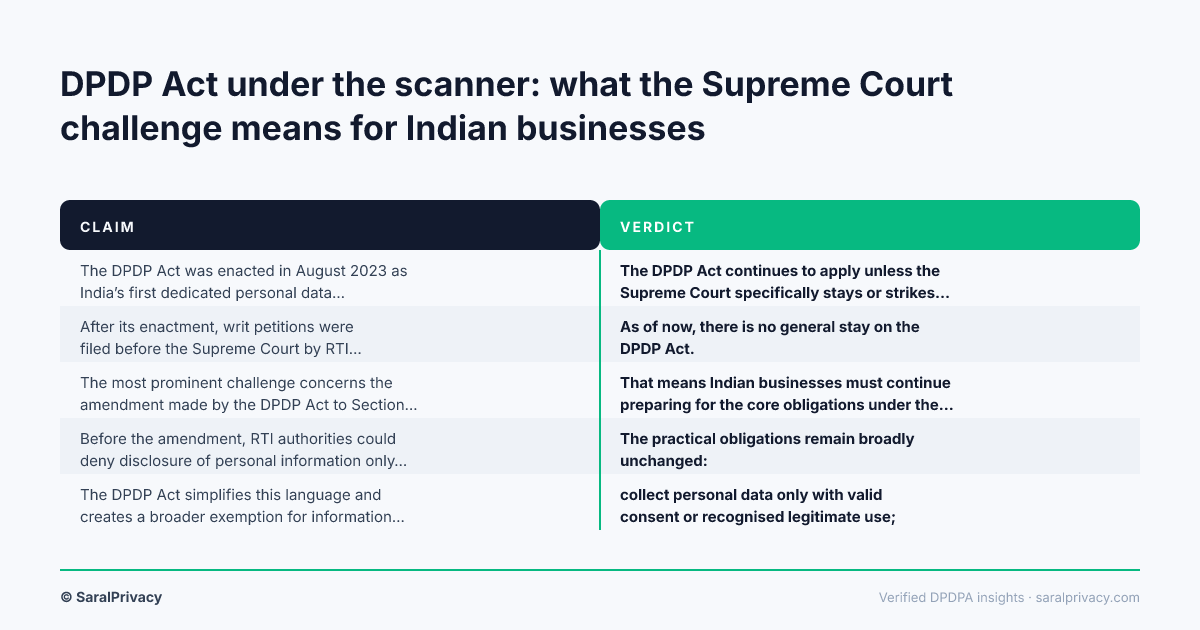
The DPDP Act is under a Supreme Court challenge. The headlines are loud. The instinct is to wait. Three things are still true: The Act has not been stayed. The DPDP Rules, 2025 are moving through notification. Your customers are already auditing vendor DPDPA posture. Privacy readiness work should not pause. The judgment may sharpen the edges of the law. But Indian businesses should continue preparing for DPDPA compliance now.
What Changed
The DPDP Act was enacted in August 2023 as India’s first dedicated personal data protection law.
After its enactment, writ petitions were filed before the Supreme Court by RTI activists, journalists, civil society groups and members of the legal community. These petitions challenge specific parts of the law, not the entire idea of data protection.
The most prominent challenge concerns the amendment made by the DPDP Act to Section 8(1)(j) of the Right to Information Act, 2005.
Before the amendment, RTI authorities could deny disclosure of personal information only after applying certain public-interest tests. The older provision allowed disclosure where a larger public interest justified it. It also carried an important safeguard: information that could not be denied to Parliament or a State Legislature could not be denied to a citizen.
The DPDP Act simplifies this language and creates a broader exemption for information relating to personal information.
That change is now under constitutional scrutiny.
Petitioners argue that the amendment may weaken transparency, especially around information concerning public servants, public institutions, qualifications, assets, disciplinary records and other matters of public interest.
Some petitions also raise concerns around:
- ✓independence of the Data Protection Board;
- ✓breadth of the Government’s rule-making powers;
- ✓lack of explicit exemptions for journalism, research and public-interest reporting;
- ✓possible chilling effects on transparency and accountability.
For businesses, the important point is simple:
What the Law Actually Says
The DPDP Act continues to apply unless the Supreme Court specifically stays or strikes down relevant provisions.
As of now, there is no general stay on the DPDP Act.
That means Indian businesses must continue preparing for the core obligations under the law.
The practical obligations remain broadly unchanged:
- ✓collect personal data only with valid consent or recognised legitimate use;
- ✓provide clear and accessible privacy notices;
- ✓use personal data only for the purpose communicated;
- ✓keep data only as long as necessary;
- ✓maintain reasonable security safeguards;
- ✓support data principal rights;
- ✓manage grievances;
- ✓notify personal data breaches as required;
- ✓ensure processors and vendors handle data properly.
The Supreme Court challenge mainly tests whether certain provisions of the Act are constitutionally valid, especially where privacy intersects with RTI, public interest, press freedom and government powers.
What Businesses Should Do Now
Businesses should not pause DPDPA readiness because of the constitutional challenge.
They should use this period to close practical gaps quietly before customers, partners, regulators or auditors ask harder questions.
Area of Focus
Action Required
Data Mapping
List where personal data sits across CRMs, HR systems, ATS tools, spreadsheets, WhatsApp groups, vendor portals, backups and cloud folders. Identify owners and access rights.
Consent Flows
Review every collection point: website forms, app screens, WhatsApp opt-ins, offline forms, candidate forms and customer onboarding journeys. Remove vague consent and pre-ticked boxes.
Privacy Notice
Rewrite your privacy notice in plain language. State what data is collected, why it is collected, how long it is retained, who it is shared with and how users can raise requests.
Retention Schedule
Define how long each category of personal data is retained. CVs, customer records, invoices, support tickets and marketing leads should not be kept forever by default.
Vendor Contracts
Review contracts with payroll providers, cloud tools, email platforms, payment gateways, CRMs, marketing tools and outsourced processors. Add data protection obligations where missing.
Rights Request Process
Create a dedicated email, owner and SLA for access, correction, erasure and grievance requests. Do not wait until the first request arrives.
Breach Response
Prepare a breach response runbook. Identify who acts in the first 24–72 hours, who informs leadership, who handles customer communication and who coordinates with vendors.
Leadership Briefing
What Is Still Uncertain
Some issues remain genuinely uncertain because the Supreme Court challenge and final regulatory implementation are still evolving.
Businesses should track these areas, but not use them as an excuse to pause.
- ✓RTI and Personal Data Disclosure
The biggest open question is how the Supreme Court will interpret the amended RTI exemption for personal information.
The Court may uphold the amendment, strike it down, or read it down to preserve public-interest disclosure.
This matters most for public authorities, journalists, civil society, public-sector entities and government-linked data ecosystems.
For most private businesses, this is important to understand but does not directly change everyday DPDPA obligations.
- ✓Press, Research and Public-Interest Exemptions
The Act does not contain a strong, standalone exemption for journalism, academic research, public-interest investigation or whistle-blowing.
The Supreme Court may influence how these areas are interpreted.
This is especially relevant for:
- ✓media companies;
- ✓research organisations;
- ✓civic-tech platforms;
Top Mistakes to Avoid
Businesses should avoid these common errors while reading the Supreme Court challenge.
- ✓Assuming the DPDP Act Has Been Stayed
It has not been stayed.
A constitutional challenge does not automatically pause a law. Unless the Court grants a stay or strikes down a provision, the law continues to operate.
Waiting on this assumption is risky.
⸻
- ✓Treating the RTI Issue as a Private-Sector Compliance Escape Route
The RTI challenge is important, but it does not remove the privacy obligations of private businesses.
A recruitment agency, CA firm, D2C brand, SaaS company or training institute cannot use the RTI debate as a reason to delay privacy notices, consent flows, retention rules or vendor reviews.
⸻
- ✓Waiting for Final Rules Before Doing Anything
Some details may still evolve, but the core work is already obvious.
You do not need final rules to begin:
- ✓data mapping;
- ✓consent cleanup;
Sources
- 1.The Digital Personal Data Protection Act, 2023 — Gazette of India Extraordinary, Part II, Section 1, No. 45, dated 11 August 2023 (S.O. 3544(E))[Gazette]
- 2.Digital Personal Data Protection Act 2023, Section 44(3), which substitutes Section 8(1)(j) of the RTI Act 2005 — verify against MeitY official Act text published on India Code portal[Act text]
- 3.Verify current status of Supreme Court Writ Petition(s) challenging DPDPA — check Supreme Court of India case status portal for any interim orders; as of available information no general stay has been granted[Court judgment]
- 4.Digital Personal Data Protection Act 2023, Schedule 1 — Penalties; Item 1 specifies up to ₹250 crore for failure to take reasonable security safeguards under Section 8(5)[Act text]
- 5.Digital Personal Data Protection Rules 2025, notified via Gazette of India — verify specific rules covering consent managers (Rule 4), breach notification timelines, and SDF criteria to assess what is resolved vs. still pending[Notified Rules]
- 6.DPDP Rules 2025 — verify Rule on breach notification to Data Protection Board; confirm exact prescribed timeline and whether 72-hour window is the notified standard or an approximation[Notified Rules]
- 7.Digital Personal Data Protection Act 2023, Sections 11–14 — right to information (S.11), correction and erasure (S.12), grievance redressal (S.13), nomination (S.14)[Act text]
Get daily briefings by email
2-min reads, plain English, every morning. Free forever.
Need expert guidance?
Our team helps Indian businesses turn DPDPA readiness into a visible trust signal.
Get Consultation →