
Two clocks, two regulators: CERT-In's six hours and the DPDP 72-hour Board report
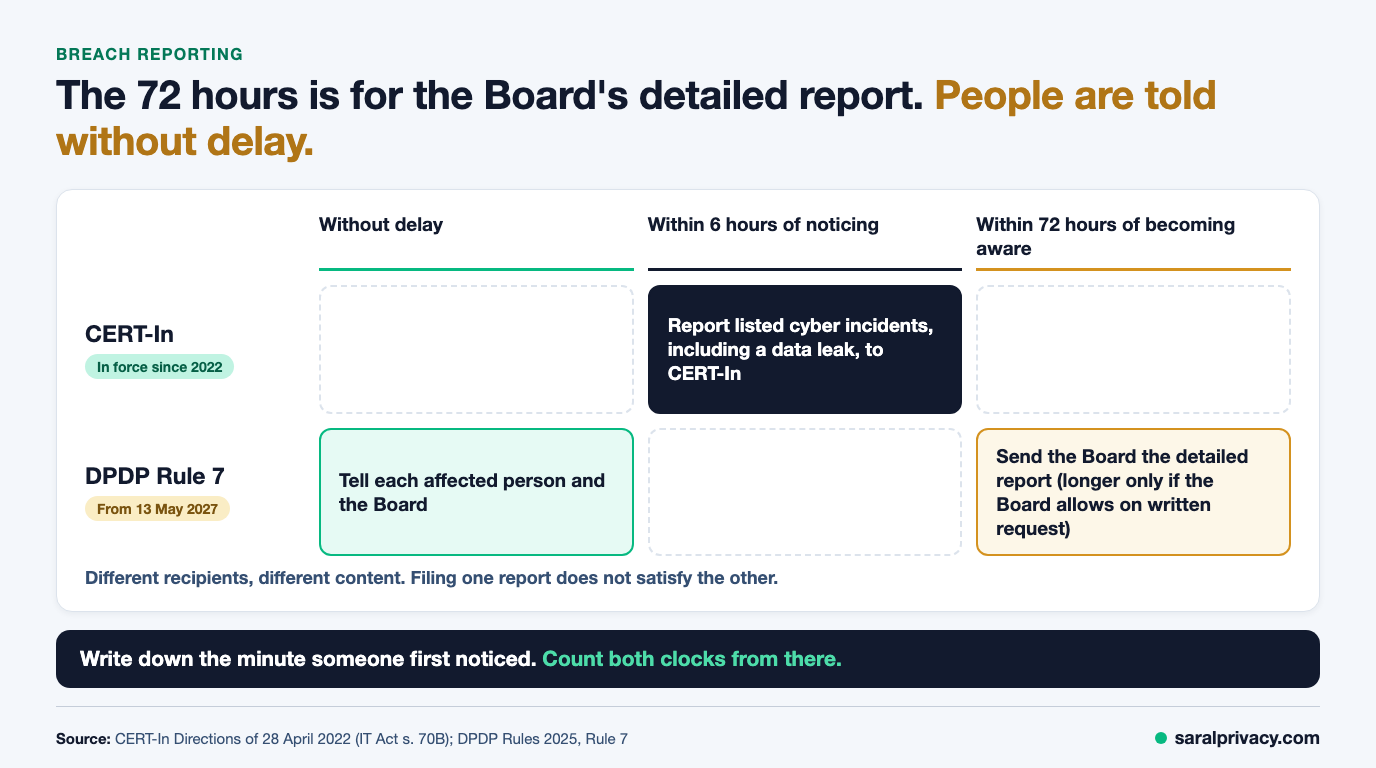
Two breach clocks, two regulators: CERT-In's six-hour reporting and the DPDP Rule 7 duties. A side-by-side timeline, example and a one-page incident log.
TL;DR
- ✓Tell people without delay. The 72 hours is for the Board's detailed report.
- ✓CERT-In applies now. Rule 7 starts on 13 May 2027.
- ✓Write down the minute someone first noticed. Count both clocks from there.
When customer data leaks, which clock starts, and who do you tell?
Two clocks, two recipients. CERT-In directions of 28 April 2022, already in force under the IT Act, require service providers, intermediaries, data centres, bodies corporate and government organisations to report listed cyber incidents within six hours of noticing them. The list includes data breaches and data leaks. DPDP Rule 7, which starts on 13 May 2027, asks you to tell each affected person and the Data Protection Board without delay, and then to give the Board a detailed report within 72 hours of becoming aware, or longer if the Board allows that on a written request. Filing one report does not satisfy the other.
"We have 72 hours to tell customers" is the sentence that loses the morning.
Tuesday, 10:00
Picture Anil (an illustrative example, not a real incident). He leads operations at an online jewellery retailer. On Tuesday at 10:00 a support lead finds a misconfigured cloud storage folder. Customer order records are exposed: names, addresses and phone numbers.
Someone on the group chat says the team has 72 hours before anyone outside needs to know. Someone else says a CERT-In filing will cover the Board as well.
Anil's worry is fair. The folder is still open while the group debates the word "breach". The clocks, where they apply, run from the minute someone noticed, not from the end of the debate.
The two clocks
| CERT-In directions (IT Act) | DPDP Act and Rule 7 | |
|---|---|---|
| Who is told | CERT-In, the national cyber agency | Each affected person and the Data Protection Board |
| What triggers it | Specified cyber security incidents, which include data breaches and data leaks, once you notice them | A personal data breach: unauthorised processing, or accidental disclosure, loss of access and similar events affecting personal data |
| Timing | Within six hours of noticing, or of being told | Both groups without delay; then fuller details to the Board within 72 hours of becoming aware, or longer if the Board allows on written request |
| Applies now? | Yes, since 2022 | No. Rule 7 starts on 13 May 2027 |
| What you send | The incident details CERT-In asks for | People: what happened, likely consequences, steps taken, steps they can take, a contact. Board: a first description (nature, extent, timing, place, likely impact), then a detailed report |
Two further points sit beside the table. CERT-In's directions also require the logs of ICT systems to be kept for a rolling 180 days, within India. Sector regulators, for banks, insurers and market intermediaries, may have their own reporting rules and timings. Confirm the current text before you name one of those timings in your own playbook.
Tell people without delay. The 72 hours belongs to the Board's detailed report.
Two traps the numbers set
Trap 1: Wait 72 hours to write to customers. Rule 7 does not say that. Affected people are told without delay. The 72-hour mark is for the detailed information to the Board.
Trap 2: File with CERT-In and stop. Different recipients, different content, different rules. A CERT-In report does not tell your customers, and it does not tell the Board.
Before 13 May 2027 the DPDP rows are practice. The CERT-In row is live, if the event is on the directions' list of reportable incidents and your organisation is one of the kinds they name.
What "becoming aware" means on that Tuesday
Both regimes turn on when you know. CERT-In counts from noticing the incident, or being told of it. Rule 7 counts from becoming aware. Neither text says whose knowledge counts, so take the cautious reading: the minute anyone in the business first noticed. Decide in advance who can declare an incident. Write down the minute it was first noticed, and the minute that person was told. Those two times are the first thing anyone will ask for.
Anil's timeline, once the lead has authority:
| Time | Action | Why |
|---|---|---|
| 10:00 | Incident lead records the time the folder was found and closes the exposure | The clocks count from here, and the harm stops |
| By 16:00 | Report to CERT-In, if the event is a reportable incident | The six-hour mark in the CERT-In direction |
| Early | Alert whoever advises you, and check any sector regulator's timing | Another clock may be running |
| Without delay | Tell affected customers in plain language, through their account or their registered contact | Rule 7, once it is in force |
| Without delay | Tell the Board | Rule 7, once it is in force |
| Within 72 hours | Send the Board the detailed report | Rule 7, once it is in force |
| Afterwards | Fix the cause, update the logs and the register | Rule 6 safeguards, and a record of what you decided |
What the note to people contains
Rule 7 asks for plain language and these five items:
- ✓what happened, including its nature, extent and timing;
- ✓the likely consequences for the person;
- ✓what you have done, or are doing, to reduce harm;
- ✓what the person can do to protect herself;
- ✓a business contact for questions.
Draft them now. You will not want to invent them while the folder is still being closed. The wider topic is the breach response guide. Terms sit in the glossary.
One log for both clocks
| Field | Example entry |
|---|---|
| Incident ID | INC-014 |
| Time first noticed and by whom | 10:00, support lead |
| Time of authority's awareness | 10:20, incident lead |
| Systems and data types involved | Storage folder; names, phones, addresses |
| Number of people affected (estimate) | Count to be confirmed |
| CERT-In report sent (time, reference) | 15:10, ref noted |
| Board notified (time, reference) | |
| People notified (time, channel) | |
| Detailed Board report sent (time) | |
| Other regulators informed | |
| Root cause and fix |
If you do not yet know how many people are affected, report what you know, without delay, and fill the rest in the later period. The Board may allow a longer period for the detailed report if you ask in writing.
Where teams lose the hours
Three places, in a real incident:
- ✓Arguing about the word breach while the clocks run. Agree a working definition in advance. Escalate when you are unsure. You can downgrade later.
- ✓Waiting for a sign-off on every word of the first message. Pre-approve the templates, so the incident lead can send the first note.
- ✓Forgetting the decisions. Why a longer period was requested. Why a regulator was told, or was not. A short decision log, written as you go, is worth more than a polished report written afterwards.
What Anil sets up this week
The month's list is longer. This week is only the names and the clock.
- ✓Name an incident lead and a deputy, with authority to declare a breach.
- ✓Write one playbook with CERT-In, the Board, affected people, and any sector regulator side by side.
- ✓Check that you can reach people. Do you have a verified contact for every account holder?
- ✓Turn logs on, and keep them, for systems that hold personal data.
- ✓Read the processor contracts for a duty to alert you quickly.
- ✓Rehearse once against the six-hour mark and once against the 72-hour mark.
This week he does item 1, and he writes one sentence on the playbook cover. The support lead may declare an incident, and the time that counts is the minute she noticed, written in the log before the folder is discussed.
If you remember three things
- ✓Tell people without delay. The 72 hours is for the Board's detailed report.
- ✓CERT-In applies now. Rule 7 starts on 13 May 2027.
- ✓Write down the minute someone first noticed. Count both clocks from there.
Write the minute. Then close the folder.
If this split the two clocks for you, send it to one founder, one IT lead, or one ops lead who still thinks a CERT-In filing also tells the customer.
FAQ
Do I report to CERT-In and the Board? If both regimes apply to the event, yes, separately. CERT-In applies now. Rule 7 applies from 13 May 2027.
Is the 72 hours for telling customers? No. Tell people without delay. The 72 hours is the period for detailed information to the Board.
What if I don't yet know how many people are affected? Report what you know, without delay, and fill in details within the later period. Note that the Board may allow a longer period for the detailed report if you ask in writing.
What are the penalty risks? The Act's Schedule has a tier for failing to give the required breach intimation (up to ₹200 crore) and a higher one for failing to take reasonable security safeguards (up to ₹250 crore). Those provisions start on 13 May 2027, and the Board decides after an inquiry.
Not legal advice. This post is general information for Indian businesses. It is not legal advice. Check the Act, the Rules and the Gazette, or ask a qualified lawyer, before you rely on it.
Not sure which clock would start if a folder were open tomorrow morning? Get a plain-English privacy readiness review from SaralPrivacy. We will map your data, score your gaps, and hand you the next three actions in writing.
Sources
- 1.CERT-In Directions No. 20(3)/2022-CERT-In under section 70B(6) of the Information Technology Act, 2000, 28 April 2022, directions (ii) and (iv) and Annexure I[Official]
- 2.Digital Personal Data Protection Rules, 2025, G.S.R. 846(E), Rule 7[Gazette]
- 3.Digital Personal Data Protection Act, 2023, sections 2(u) and 8(6)[Gazette]
- 4.Digital Personal Data Protection Act, 2023, the Schedule, items 1 and 2[Gazette]
- 5.DPDP Rules, 2025, Rule 1(4)[Gazette]
Get daily briefings by email
2-min reads, plain English, every morning. Free forever.
Need expert guidance?
Our team helps Indian businesses turn DPDPA readiness into a visible trust signal.
Get Consultation →