
What changes for your business when the first consent manager goes live
When a DPDP consent manager is registered, what changes for your business? Withdrawals from outside, consent records, contracts and a readiness checklist.
TL;DR
- ✓Check the Board's register before you believe a consent manager is live.
- ✓No provision says a business must join a consent manager's platform.
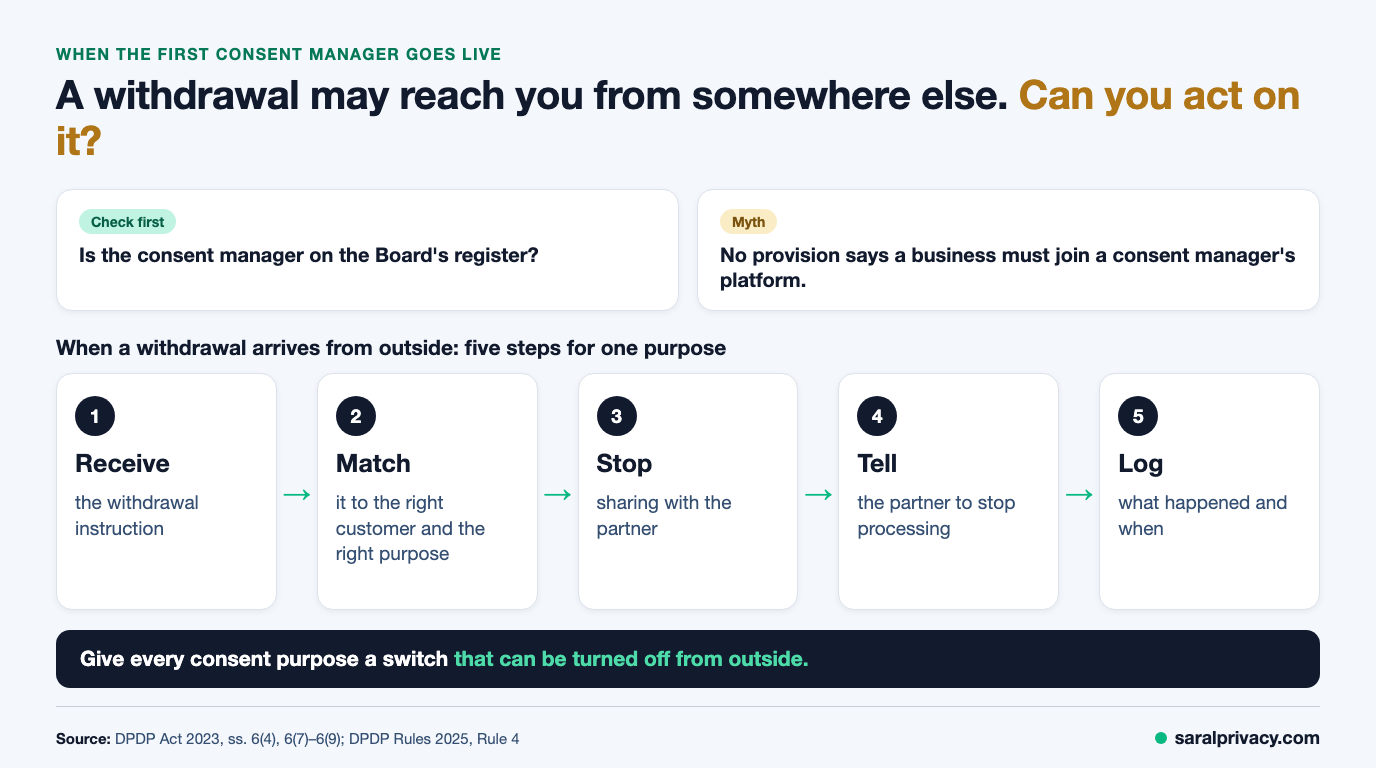
- ✓Give every consent purpose a switch that can be turned off from outside.
What lands on your desk if the Board registers a consent manager?
Registration opened on 13 November 2026, and the Data Protection Board has said it will publish registered consent managers on its website. Nobody should assume one is registered until that list shows it. From 13 May 2027, a person can manage her consents through one, so a withdrawal can reach you from outside your own app. No provision says your business must join one. The change is smaller than the vendor email and larger than "nothing".
Opening for applications and registering the first company are two different steps. The dates are in What 13 November 2026 actually starts.
The partner email
Picture Nisha (an illustrative example, not a real client). She is the product lead at a subscription fitness app. The app asks for consent for three purposes. They are running the account, sending workout tips, and sharing usage data with a research partner.
On Monday a partner forwards an email: "The first consent manager is live. Integrate before the deadline."
Nisha's worry is fair. If a customer withdraws the research purpose and the app keeps sharing, the withdrawal is a sentence on a screen and nothing else.
Most teams either start a build that week or archive the email. Both miss the question the email was standing in for.
What a consent manager is, in one paragraph
Under section 6(7) of the Act, which starts on 13 May 2027, a person can give, manage, review and withdraw consent through a consent manager: a company registered with the Board. The Act makes it accountable to the person. The Rules say it must keep records and be built so it cannot read the personal data passing through it. The comparison is in Cookie-banner tool vs DPDP consent manager.
No provision of the Act or the Rules says a business must join one. If a customer chooses to use one, and has given you consent, her instructions can reach you from outside your own app. Whether you must buy one is a separate question, answered in Do you need a consent manager?.
A partner email is not the Board's register.
Two traps the email sets
Trap 1: Integrate because the subject line said "live." "The first consent manager is live, so you must integrate now" is a claim the Act does not make. "Our product is a registered consent manager" needs an entry on the Board's published register. "Connect before the deadline" points at the wrong date for ordinary duties: those start on 13 May 2027.
Trap 2: Archive the email and leave withdrawal inside one screen. People who never use a consent manager will still deal with you directly. People who do use one may send a stop from outside. If your only path is the preference centre, the outside letter has nowhere to land.
Five things that could change
1. Withdrawals may arrive from somewhere else
Today, a person withdraws consent in your preference centre or by emailing you. Section 6(4) says withdrawal must be about as easy as giving consent, and section 6(7) lets a person use a consent manager for this. So you may need a way to receive and act on a withdrawal that did not start inside your product.
Ask your engineers: can a withdrawal reach our systems from an outside source, and does it stop the right processing?
2. Your records need to say where consent came from
If some consents are given directly and some are managed through an intermediary, your logs should show which is which. That matters when you have to prove consent. Under section 6(10), the burden of proof is on the business.
3. Your contracts will get tested
Picture this chain: a consent manager tells you a customer withdrew consent; you tell your email vendor; the vendor tells its analytics sub-processor. Who is responsible for each step, and how fast? If your processor contracts are silent, add terms now. Section 6(6) says that after a withdrawal you must stop, and make your processors stop, within a reasonable time. The Act keeps you responsible for what your processors do with the data.
4. Each relationship stays separate
A consent manager gives the person one place to see her consents. It does not merge the legal relationships. Treat each withdrawal as a request directed at your business and your purposes, and handle it that way.
5. Data sharing may become more structured
Where a consent manager is used to share data between businesses, for example a lender asking for a person's data from another institution, the Rules require the consent manager to keep records of the sharing. Your side of that exchange still needs a lawful basis and security safeguards.
What does not change
- ✓Your duties as a Data Fiduciary stay: notice (Rule 3), consent or another lawful ground, security safeguards (Rule 6), breach intimation (Rule 7), and rights handling (Rule 14).
- ✓No duty to join. Neither the Act nor the Rules has a line that says a business must join a consent manager's platform.
- ✓Your own consent flow. People who do not use a consent manager will still deal with you directly.
No rule makes you join. A withdrawal you cannot act on is a broken promise.
Nisha's five steps for one purpose
A customer uses a consent manager to withdraw the third purpose, the research share. For that to work, the app needs to:
- ✓receive the instruction;
- ✓match it to the right customer and the right purpose;
- ✓stop sharing with the partner;
- ✓tell the partner to stop processing, if the partner is a processor or a recipient;
- ✓log what happened and when.
If any step is manual and slow, the withdrawal will not mean much.
The question for engineering this week
Ask: can our systems receive an instruction from an outside party that says "stop processing this purpose for this person"? How long would it take to act on it across every system? Where do we record that the instruction arrived, and what we did? Who owns the answer if a processor is slow?
Write the replies down, even where the reply is "we do not know yet". The list of unknowns is the readiness plan, and it costs nothing while you wait to see whether any consent manager is registered.
The checklist that sits behind that question:
- ✓ We can name every purpose we rely on consent for
- ✓ Each purpose has a switch that stops the processing behind it
- ✓ Withdrawal requests from an outside source can be received, verified and logged
- ✓ Records show whether consent was given directly or through an intermediary
- ✓ Processor contracts say how quickly they act on a withdrawal
- ✓ Someone watches the Board's register for new consent managers
- ✓ Our staff know a withdrawal needs no justification
How to judge a tool that offers the connection is in the vendor-neutral guide. Terms sit in the glossary.
If you remember three things
- ✓Check the Board's register before you believe a consent manager is live.
- ✓No provision says a business must join a consent manager's platform.
- ✓Give every consent purpose a switch that can be turned off from outside.
Check the register before you start the build.
If this shrank the email to a real question, send it to one product lead, one engineering lead, or one founder who was told to integrate before a deadline.
FAQ
Is a consent manager live yet? Check the Board's website. Companies have been able to apply since 13 November 2026, but opening for applications and registering the first company are two different steps.
Do I have to pay a consent manager? That depends on the arrangement between the consent manager and the businesses it connects with. Neither the Act nor the Rules sets a fee. Read any contract carefully.
Will lenders and insurers be affected first? They may well be, because consent-based data sharing already exists in financial services. Whether that happens depends on who registers.
Can a consent manager read my customers' data? The Rules say it must be set up so that data passed through it is not readable by it.
Not legal advice. This post is general information for Indian businesses. It is not legal advice. Check the Act, the Rules and the Gazette, or ask a qualified lawyer, before you rely on it.
Not sure whether an outside withdrawal could reach your systems? Get a plain-English privacy readiness review from SaralPrivacy. We will map your data, score your gaps, and hand you the next three actions in writing.
Sources
- 1.Digital Personal Data Protection Act, 2023, sections 6(4), 6(6), 6(7) and 6(10)[Gazette]
- 2.Digital Personal Data Protection Rules, 2025, G.S.R. 846(E), First Schedule, Part B[Gazette]
- 3.Press Information Bureau, Ministry of Electronics and IT, release ID 2336151, 14 November 2026[Official]
- 4.G.S.R. 843(E), 13 November 2025; DPDP Rules, 2025, Rule 1(4)[Gazette]
Get daily briefings by email
2-min reads, plain English, every morning. Free forever.
Need expert guidance?
Our team helps Indian businesses turn DPDPA readiness into a visible trust signal.
Get Consultation →