
The DPDPA Data Protection Officer: A Practical Guide for Significant Data Fiduciaries
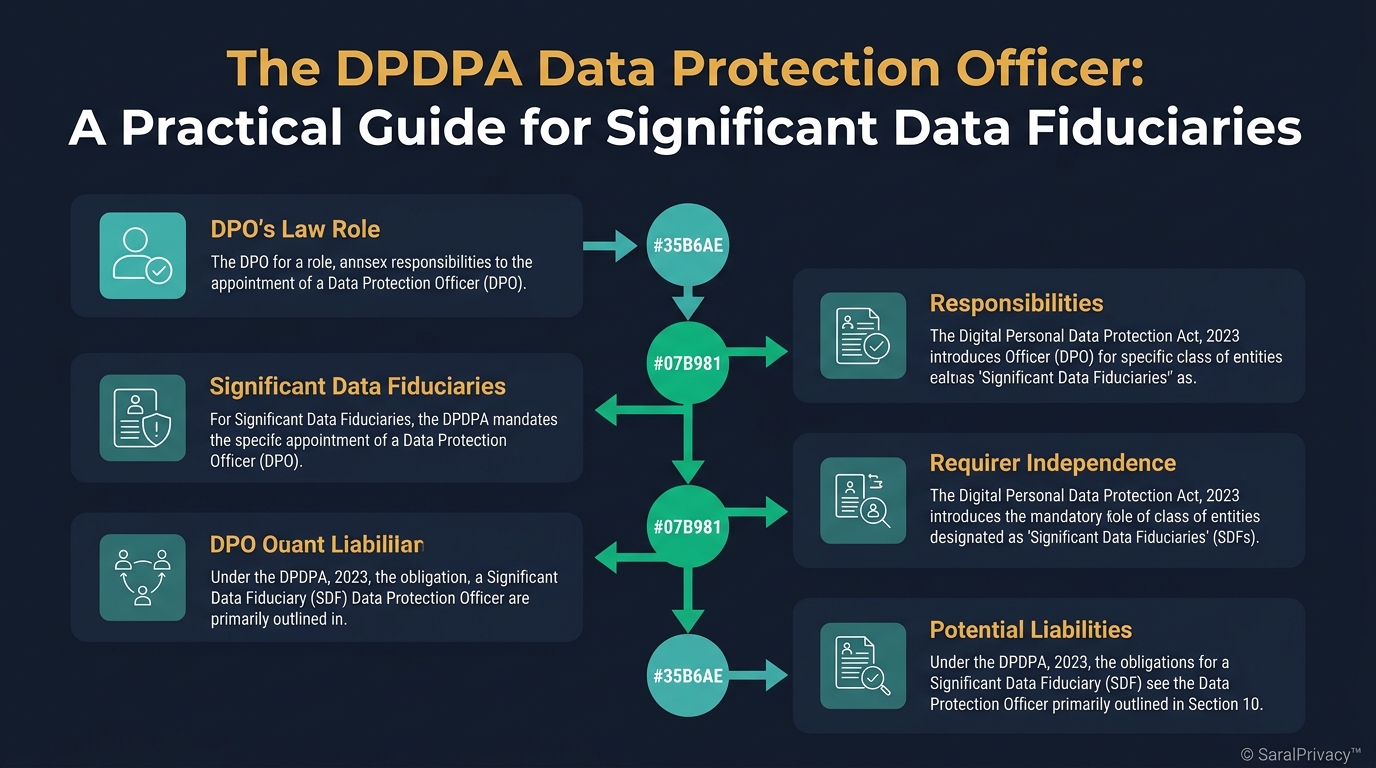
For Significant Data Fiduciaries, the DPDPA mandates the appointment of a Data Protection Officer (DPO). This guide clarifies the DPO's role, responsibilities, required independence, and potential liabilities, providing a practical framework for compliance and risk management under India's new privacy law.
What Changed
The Digital Personal Data Protection Act, 2023, introduces the mandatory role of a Data Protection Officer (DPO) for a specific class of entities designated as 'Significant Data Fiduciaries' (SDFs). This formalizes a senior, independent privacy oversight function that was not a universal legal requirement under the previous IT Rules, 2011. The DPO's mandate goes beyond the erstwhile 'Grievance Officer' role, focusing on comprehensive compliance monitoring, advising leadership, and acting as the primary liaison with the Data Protection Board of India. This marks a structural shift towards embedding accountability within organisations that handle large volumes or sensitive types of personal data.
What the Law Actually Says
Under the DPDPA, 2023, the obligations for a Significant Data Fiduciary (SDF) concerning the Data Protection Officer are primarily outlined in Section 10.
- ✓Appointment Mandate: Section 10(2)(a) requires every SDF to appoint a Data Protection Officer who must be based in India.
- ✓Board Accountability: The DPO must report to the Board of Directors or a similar governing body of the SDF, as per Section 10(2)(c). The DPO is responsible to this body.
- ✓Role as Point of Contact: Section 10(2)(b) specifies that the DPO shall be the point of contact for the grievance redressal mechanism under the Act.
- ✓Representation: The DPO is tasked with representing the SDF in proceedings before the Data Protection Board of India.
While the Act establishes the role, the specific qualifications and other detailed requirements are expected to be prescribed in the forthcoming DPDP Rules.
What Businesses Should Do Now
Businesses likely to be classified as SDFs must proactively structure the DPO function to ensure compliance and effective oversight. The focus should be on establishing a role with genuine authority and independence.
| Area of Focus | Action Required |
|---|---|
| Role Definition & Structure | Draft a detailed Job Description outlining responsibilities: compliance monitoring, conducting Data Protection Impact Assessments (DPIAs), managing data principal grievances, and acting as the liaison to the Data Protection Board. |
| Reporting Line & Independence | Ensure the DPO reports directly to the Board of Directors or the highest governing body, as mandated by Section 10(2)(c). The DPO must not report to functions with conflicting interests, such as IT, Marketing, or Product Development. |
| Qualifications & Recruitment | Recruit an individual with a strong background in data protection law (Indian and international), information security principles, and risk management. While rules are pending, prioritize demonstrated expertise over simple certifications. |
| Resource Allocation | Allocate a sufficient budget for the DPO function, including staffing (analysts, legal support), technology tools for monitoring, and continuous training. An under-resourced DPO cannot fulfill their mandate. |
What Is Still Uncertain
Despite the statutory mandate now supported by the notified DPDP Rules 2025, certain interpretive and operational questions surrounding the DPO role remain genuinely unresolved.
- ✓DPO Qualifications: The DPDP Rules 2025 do not prescribe specific minimum qualifications, certifications, or experience levels for a DPO. The Act and the notified Rules establish the appointment obligation under Section 10(2)(a) and Rule 12 respectively, but leave the determination of appropriate expertise to the appointing SDF. This remains an area where organisations must exercise their own judgment in the absence of prescribed standards.
- ✓Scope of Personal Liability: The DPDPA does not explicitly detail the scenarios under which a DPO could face personal exposure. While the Data Fiduciary bears liability for penalties under the Act, the extent of any professional accountability attributable specifically to the DPO for acts or omissions in the course of their duties is not addressed in the Act or the notified Rules and remains a genuine area of legal ambiguity.
- ✓Enforcement on Independence: It remains unclear how the Data Protection Board will assess and enforce the DPO's independence in practice, and how the DPO's responsibility to the Board of Directors under Section 10(2)(c) will be evaluated during regulatory proceedings or investigations.
Top Mistakes to Avoid
Organizations implementing the DPO role should avoid common pitfalls that undermine its effectiveness and create compliance risks.
- ✓Appointing a DPO with Conflicting Interests: A frequent error is assigning the DPO role to a senior executive whose primary job involves data processing, such as the Chief Technology Officer or Chief Marketing Officer. This creates an inherent conflict of interest, violating the principle of independent oversight.
- ✓Making the DPO the 'Scapegoat' for Compliance: The Data Fiduciary (the organization) is legally responsible for compliance, not the DPO. The DPO's function is to advise, monitor, and report. A common mistake is to view the DPO as the sole owner of compliance, shifting blame rather than fixing systemic issues.
- ✓Under-resourcing the Function: Appointing a DPO in name only, without providing a budget, a team, or the necessary tools, renders the role ineffective. The DPO must have adequate resources to monitor the data processing activities of a large organization.
- ✓Assuming GDPR DPO Role is Identical: While GDPR provides a useful model, simply copying its DPO framework is a mistake. The Indian DPO's role, accountability to the board, and interaction with the regulator will be defined by the DPDPA and the Data Protection Board of India, which may have different nuances and enforcement priorities.
Sources
- 1.Digital Personal Data Protection Act, 2023, Section 10(2)(a), (b), (c) — Ministry of Law and Justice Gazette Notification, 11 August 2023, No. 60 of 2023[Act text]
- 2.Digital Personal Data Protection Rules, 2025 — MeitY, notified via Official Gazette, Rule 12 (SDF designation criteria) — verify Rule numbers addressing DPO qualifications[Notified Rules]
- 3.DPDP Rules 2025, Rule 12 — Central Government criteria for SDF designation; this claim needs immediate correction if Rules are in effect[Notified Rules]
- 4.Digital Personal Data Protection Act, 2023, Section 10 — verify precise sub-clause; cross-reference DPDP Rules 2025 for any procedural representation rules[Act text]
- 5.Digital Personal Data Protection Act, 2023, Schedule (Penalties) — verify Schedule item for the relevant breach category applicable to SDFs[Act text]
- 6.Digital Personal Data Protection Act, 2023, Section 10(2)(d) — Data Protection Impact Assessment obligation for SDFs; distinguish from GDPR Article 35 DPIA to avoid framework conflation[Act text]
Get daily briefings by email
2-min reads, plain English, every morning. Free forever.
Need expert guidance?
Our team helps Indian businesses turn DPDPA readiness into a visible trust signal.
Get Consultation →