
Navigating DPDPA: A Practical Guide to Selecting a Consent Management Platform
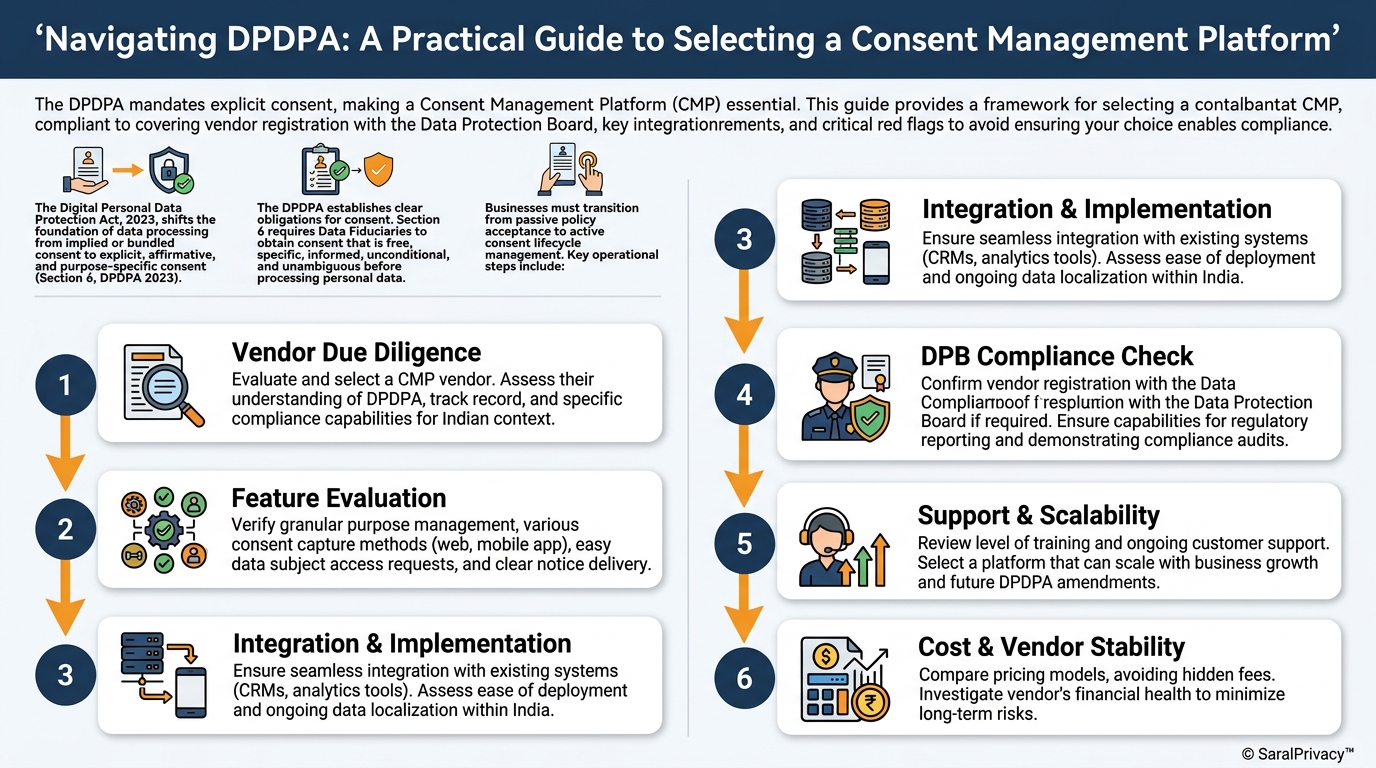
The DPDPA mandates explicit consent, making a Consent Management Platform (CMP) essential. This guide provides a framework for selecting a compliant CMP, covering vendor registration with the Data Protection Board, key integration requirements, and critical red flags to avoid ensuring your choice aligns with the DPDPA and the DPDP Rules, 2025.
What Changed
The Digital Personal Data Protection Act, 2023, shifts the foundation of data processing from implied or bundled consent to explicit, affirmative, and purpose-specific consent (Section 6, DPDPA 2023). This necessitates a move beyond simple cookie banners to robust Consent Management Platforms (CMPs). Furthermore, the Digital Personal Data Protection Rules, 2025, notified on 6 January 2025 and now in effect, introduce a new regulated entity: the 'Consent Manager' (Rule 4, DPDP Rules 2025). This means that third-party CMP providers will need to register with the Data Protection Board, adding a new layer of diligence for Data Fiduciaries when selecting a vendor.
What the Law Actually Says
The DPDPA establishes clear obligations for consent. Section 6 requires Data Fiduciaries to obtain consent that is free, specific, informed, unconditional, and unambiguous before processing personal data, except for certain legitimate uses under Section 7. Section 6(4) grants Data Principals the right to withdraw their consent at any time, with the same ease as giving it. The DPDP Rules 2025, further stipulate that entities providing consent management services, referred to as 'Consent Managers,' must register with the Data Protection Board of India. These managers are required to adhere to specific operational and security standards, including maintaining audit logs for a minimum period.
What Businesses Should Do Now
Businesses must transition from passive policy acceptance to active consent lifecycle management. Key operational steps include:
- ✓Vendor Due Diligence: Evaluate and select a CMP vendor. A critical step is to verify that the vendor is registered (or has a clear roadmap for registration) as a 'Consent Manager' with the Data Protection Board, as required under Rule 4 of the DPDP Rules 2025. Note that the Data Protection Board's registration process for Consent Managers is not yet operationalised; businesses should monitor official notifications from the Ministry of Electronics and Information Technology (MeitY) and factor registration readiness into vendor selection criteria accordingly.
- ✓Contractual Safeguards: Execute a DPDPA-specific Data Processing Agreement (DPA) with the chosen CMP vendor. This DPA must explicitly cover data residency in India for consent records, security standards (e.g., ISO 27001), breach notification support in the manner prescribed under the DPDPA 2023 and DPDP Rules 2025, and sub-processor approvals.
- ✓System Configuration: Configure the CMP to capture granular consent for distinct purposes (e.g., marketing, analytics, personalization). The platform must maintain a detailed, immutable audit trail of all consent actions.
- ✓Implement Withdrawal Mechanism: Ensure the CMP provides a simple, easily accessible mechanism for users to withdraw consent, as required under the DPDPA 2023. This withdrawal must trigger automated revocation of processing permissions in downstream systems.
- ✓Core System Integration: A CMP cannot be a silo. It must be deeply integrated with core business systems, including Data Management Systems (DMS), Customer Data Platforms (CDPs), and marketing automation tools, to ensure consent preferences are respected in real-time across all operations.
What Is Still Uncertain
While the DPDPA provides the framework, several operational details remain pending clarification:
- ✓Rules Notified, Implementation Details Pending: The Data Protection Rules, 2025 were notified on 6 January 2025 (Gazette of India). However, certain procedural and operational details for Consent Managers — including specific compliance timelines and implementation guidance — are yet to be fully established through further official communication.
- ✓DPB Registration Process: The specific technical criteria, timelines, and formal procedures for the Data Protection Board's registration and oversight of Consent Managers are not yet public.
- ✓Technical Standards: The government or the DPB has not yet issued specific technical or interoperability standards for Consent Managers, which could impact how different platforms communicate consent signals.
- ✓Enforcement Posture: The DPB's approach to enforcing non-compliance related to consent management, including the application of penalties for inadequate CMP implementation (which can be up to ₹250 crore), is yet to be established through precedent.
Top Mistakes to Avoid
Organizations risk significant penalties by making these common mistakes:
- ✓Choosing a Non-Registered Vendor: Partnering with a CMP provider that is not registered with the Data Protection Board of India. This is a fundamental compliance failure.
- ✓Ignoring Data Residency as a Risk Factor: Using a global CMP without a contractual guarantee that consent records and audit logs are stored on servers within India. Note that no explicit data localisation obligation for consent records is currently prescribed under the DPDPA Act 2023 or the notified DPDP Rules 2025; however, ensuring geographic clarity over where consent data is stored is a strongly recommended risk-mitigation best practice, particularly where future rules may impose residency obligations.
- ✓Accepting a Generic DPA: Relying on a standard GDPR-focused Data Processing Agreement that fails to address specific DPDPA requirements. Under Section 8(2) of the DPDPA Act 2023, a Data Fiduciary remains accountable for ensuring that any Data Processor it engages handles personal data only in accordance with a valid contract and the obligations under the Act. A GDPR-centric agreement will not reflect these obligations, the Data Protection Board of India's adjudicatory powers under Chapter VII of the Act, or the breach notification timelines applicable under Section 8(6).
- ✓Implementing a Complicated Withdrawal Process: Making it difficult for users to withdraw consent through multiple steps or hard-to-find links. The DPDPA Act 2023 (Section 5) mandates that the process for withdrawing consent must be as easy as the process for giving consent.
- ✓
Sources
- 1.Digital Personal Data Protection Act, 2023, Section 6(1) — available on India Code: https://www.indiacode.nic.in[Act text]
- 2.Digital Personal Data Protection Rules, 2025, Rule 4 — notified via Gazette of India Extraordinary, Part II, Section 3(i), dated 6 January 2025[Notified Rules]
- 3.Digital Personal Data Protection Act, 2023, Section 6(4) — not Section 8 as stated in the post[Act text]
- 4.Digital Personal Data Protection Act, 2023, Schedule — Penalty provisions; cross-reference Section 33[Act text]
- 5.No 72-hour window exists in DPDPA 2023 or DPDP Rules 2025. See Section 8(6) of the Act and Rule 7 of DPDP Rules 2025 for the actual breach intimation framework — remove or correct this claim[Notified Rules]
- 6.DPDP Rules 2025 do not currently mandate India-only storage for consent records specifically. Cross-reference Rule 12 on data localisation applicability. Treat as best practice pending further DPB guidance.[Notified Rules]
- 7.Digital Personal Data Protection Act, 2023, Section 6(1), published in Gazette of India Extraordinary, Part II, Section 1, No. 60, dated 11 August 2023[Act text]
- 8.Digital Personal Data Protection Rules, 2025, Rule 4 (Consent Manager), notified vide G.S.R. 37(E), Gazette of India Extraordinary, Part II, Section 3(i), dated 6 January 2025
Get daily briefings by email
2-min reads, plain English, every morning. Free forever.
Need expert guidance?
Our team helps Indian businesses turn DPDPA readiness into a visible trust signal.
Get Consultation →