
Section 9 checklist: what's banned for children's data and what to do before 13 May 2027
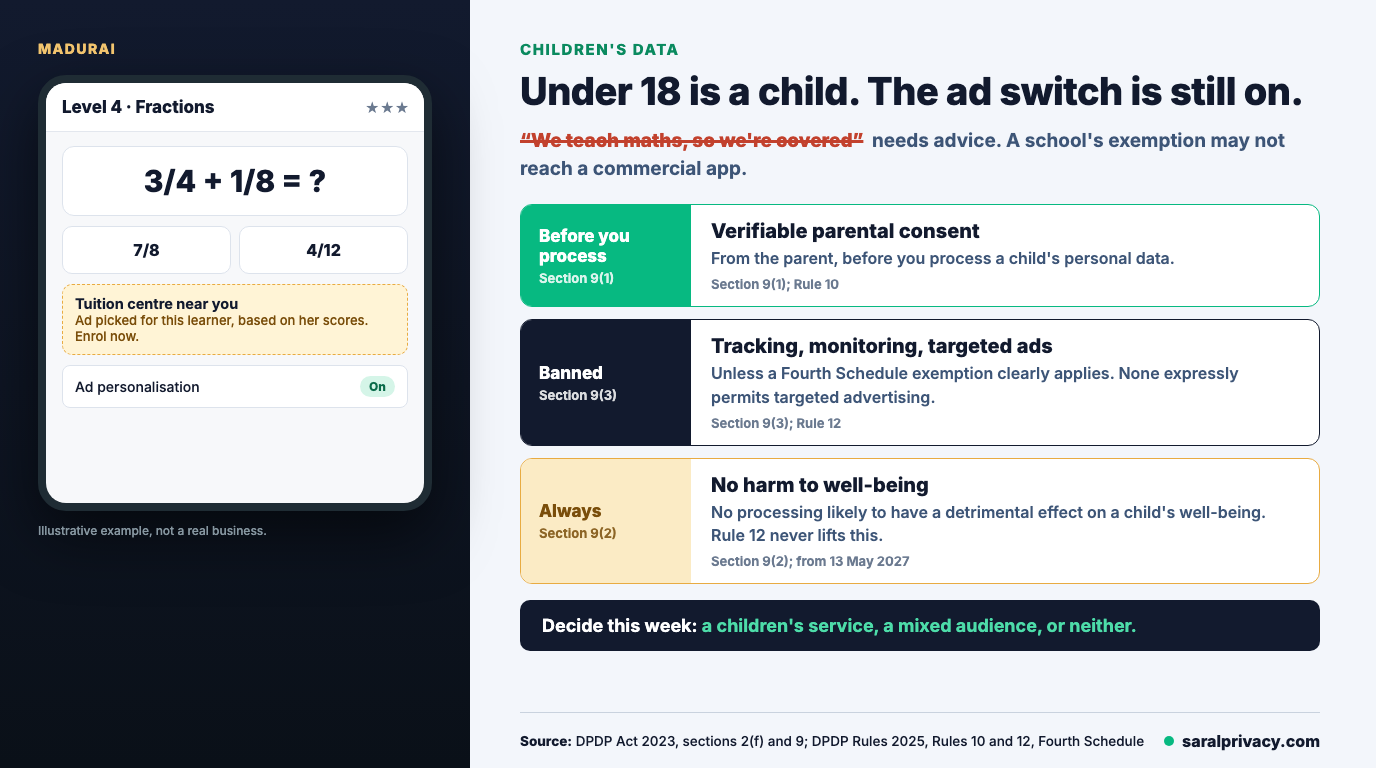
Section 9 checklist for children's data under DPDP: what's banned from 13 May 2027, who counts as a child, the Rule 12 exemptions and a plan to finish in time.
TL;DR
- ✓Under the Act, a child is under 18. Verifiable parental consent comes before you process her personal data.
- ✓Tracking, behavioural monitoring, and targeted advertising directed at children are banned unless a Fourth Schedule exemption clearly applies.
- ✓Rule 12 can lift sections 9(1) and 9(3) for listed classes and purposes. The duty not to harm a child's well-being stays.
If a child can open your app, what are you not allowed to do with what she does inside it?
If your app, website or school touches anyone under 18, section 9 of the DPDP Act is the part you cannot skip. A child is a person under 18. Before you process her personal data, you need the verifiable consent of her parent or lawful guardian. You must not process in a way likely to cause a detrimental effect on her well-being. You must not track children, monitor their behaviour, or direct targeted advertising at them, unless an exemption applies. Section 9 and the children's data rules (Rules 10 to 12) start on 13 May 2027. Age checks and parent flows take engineering time, so start planning now.
The age in the Act is 18. A lower age from another country's law does not replace it.
The maths app with the ads still on
Picture Lakshmi (an illustrative example, not a real client). She builds a maths-learning app in Madurai. It serves children aged 8 to 14. Before any redesign, it collects a child's name, school, and location, uses analytics to profile engagement, and shows ads for tuition centres.
She has heard that schools may track children for educational activities or safety. Her app is a commercial product. She wants the checklist before she decides which switch to turn off, and before she tells a parent the app is "covered because it teaches maths".
The Act also covers a person with a disability who has a lawful guardian. The guardian's consent is needed in the same way.
Two traps around age and exemptions
Trap 1: Use 16 because another law uses 16. Under the Act, a child is under 18. That is higher than the age used in some other countries' laws.
Trap 2: A commercial app relies on the educational-institution exemption without advice. Educational institutions have an exemption for tracking and behavioural monitoring, limited to their own educational activities or the safety of children enrolled with them. Whether a commercial app counts as an educational institution is not settled. Take advice before relying on it, and read the conditions.
Who counts as a child?
Under the Act, a child is a person who is under 18 years of age. That is higher than the age used in some other countries' laws. The Act also covers a person with a disability who has a lawful guardian, for whom the guardian's consent is needed in the same way.
One narrow exception exists in the Act. Under section 9(5), the government may notify a lower age for a particular fiduciary, if it is satisfied that the fiduciary processes children's data in a verifiably safe way. Above that age, that fiduciary can be exempted from sections 9(1) and 9(3). Unless a notification names you, plan for 18.
What section 9 says, in four lines
- ✓Verifiable consent first. Before processing a child's personal data, you must obtain the verifiable consent of her parent or lawful guardian (section 9(1)).
- ✓No harmful processing. You must not process in a way that is likely to cause a detrimental effect on the child's well-being (section 9(2)).
- ✓No tracking, monitoring or targeting. You must not undertake tracking or behavioural monitoring of children, or targeted advertising directed at children (section 9(3)).
- ✓Exemptions by rule. Sections 9(1) and 9(3) do not apply to classes of fiduciaries and purposes the government prescribes (section 9(4)). It has done so through Rule 12 and the Fourth Schedule.
The wider topic is children's data. Terms sit in the glossary.
What is banned
From 13 May 2027, section 9(3) bans:
- ✓tracking children;
- ✓behavioural monitoring (building profiles from what they do);
- ✓targeted advertising directed at children.
A few examples of what that can mean: an edtech app that follows a child across other websites to show ads, a game that profiles a child's spending habits to push purchases, or a kids' clothing site that retargets a child's browsing. All are risky unless a specific exemption applies.
Section 9(3) bans tracking, behavioural monitoring, and targeted advertising directed at children, unless an exemption clearly applies.
What the exemptions cover
Rule 12 says sections 9(1) and 9(3) don't apply to certain classes and purposes, subject to the conditions in the Fourth Schedule.
Classes (Part A):
- ✓clinical establishments, mental health establishments and healthcare professionals, for health services to the child, to the extent necessary to protect her health;
- ✓allied healthcare professionals supporting a treatment and referral plan;
- ✓educational institutions, for tracking and behavioural monitoring for their educational activities, or for the safety of children enrolled with them;
- ✓people running a crèche or child day-care centre, for safety monitoring;
- ✓people engaged by schools or crèches to transport children, for tracking location during travel.
Purposes (Part B):
- ✓exercising any power, function or duty in a child's interest under a law in force in India;
- ✓providing a subsidy, benefit, service, certificate, licence or permit in a child's interest, under law or policy or using public funds;
- ✓creating a user account for email communication, limited to that use;
- ✓determining a child's real-time location for her safety;
- ✓making sure harmful information, services or advertisements are not accessible to the child;
- ✓confirming that a user is not a child and carrying out the Rule 10 checks.
Three cautions. The exemptions are conditional, so read the conditions. None of them expressly permits targeted advertising at a child; the advertising item only keeps harmful ads away from her. And Rule 12 lifts sections 9(1) and 9(3) only, so the duty not to harm a child's well-being in section 9(2) is still there.
The checklist
Know whether you process children's data
- ✓ Do we ask for age or date of birth? Do we have a way to tell that a user may be under 18?
- ✓ Which products are likely to attract children (games, learning, toys, family services)?
Parent consent
- ✓ A verification step that checks the parent is an adult and identifiable (Rule 10).
- ✓ A process for guardians of persons with disabilities (Rule 11).
- ✓ Records of how each parent was verified.
Prohibitions
- ✓ No tracking or behavioural monitoring of children, unless a Fourth Schedule exemption clearly applies.
- ✓ No targeted advertising directed at children; ad SDKs are switched off or configured for child accounts.
- ✓ A review of features that could harm well-being: endless-scroll mechanics, spend nudges, public sharing of children's data.
Data practices
- ✓ Minimum data collected from child accounts.
- ✓ Keep child data no longer than needed, but not below Rule 8(3)'s one-year minimum for the data, traffic data and logs of each processing.
- ✓ Extra care with processors and analytics tools.
A worked example: Lakshmi's maths app
The app serves children aged 8 to 14. Before: it collected a child's name, school and location, used analytics to profile engagement, and showed ads for tuition centres. After redesign:
- ✓sign-up asks the age; under 18 triggers a parent flow;
- ✓the parent verifies using details the app can check, and consent is stored with the date and method;
- ✓ad SDKs are disabled in child accounts, and analytics are limited to what is needed to run the lessons;
- ✓location isn't collected;
- ✓parents can see and delete the child's data from a dashboard.
Lakshmi does not assume the "educational activities" exemption covers her engagement analytics. She takes advice before relying on it.
What to do before 13 May 2027
- ✓Decide your position: are you a children's service, a general service with some children, or neither?
- ✓Run an age-signal audit: where do you learn a user's age?
- ✓Choose a verification method and test it with real parents.
- ✓Turn off tracking for child accounts.
- ✓Update the notice so a parent can understand it.
- ✓Train support staff to handle parent requests.
What Lakshmi does this week
She writes one line at the top of the checklist: this is a children's service. The users it is built for are 8 to 14, which is under 18. She does not tick the school exemption on the same line. She writes "commercial app; take advice before relying on the educational-institution class."
She then answers the two "know whether" questions from the product as it is today. The app asks for school, not a reliable age, and it is built for children. That is enough to start the parent-flow work. Turning off the ad SDK in child accounts is the next build, not a sentence in the board note. The full six steps stay on the page through to 13 May 2027, when section 9 and Rules 10 to 12 start.
If you remember three things
Same three lines as the top.
- ✓Under the Act, a child is under 18. Verifiable parental consent comes before you process her personal data.
- ✓Tracking, behavioural monitoring, and targeted advertising directed at children are banned unless a Fourth Schedule exemption clearly applies.
- ✓Rule 12 can lift sections 9(1) and 9(3) for listed classes and purposes. The duty not to harm a child's well-being stays.
Under this Act, a child is under 18. Read the exemption before you keep a tracking switch on.
If this separated the ban from the exemption, send it to one founder, one CA, or one ops lead who still thinks a learning app can track children because it is "educational".
FAQ
Is 16 or 18 the age? Under the Act, a child is under 18. Under section 9(5), the government may exempt a fiduciary whose processing it finds verifiably safe from all or any of the duties in sections 9(1) and 9(3), above an age it notifies for that fiduciary. The definition of a child does not change.
Do schools need parental consent for everything? Educational institutions are exempt from sections 9(1) and 9(3) only for tracking and behavioural monitoring for their educational activities or the safety of children enrolled with them. Other processing still needs parental consent, unless a Part B purpose or another exemption applies. Take advice on edge cases.
Can I let a child sign up with a fake birth date? Relying on an unverified self-declared age may leave you exposed if the user is a child. Consider how you would answer the Data Protection Board.
What is the penalty? The Act's Schedule has a separate item for breach of the children's data obligations under section 9, of up to ₹200 crore. It starts on 13 May 2027, and the Board decides the amount after an inquiry. The penalty calculator shows how the Schedule is built.
Not legal advice. This post is general information for Indian businesses. It is not legal advice. Check the Act, the Rules and the Gazette, or ask a qualified lawyer, before you rely on it.
Not sure what to do first? Get a plain-English privacy readiness review from SaralPrivacy. We will map your data, score your gaps, and hand you the next three actions in writing.
Sources
- 1.Digital Personal Data Protection Act, 2023, section 2(f)[Gazette]
- 2.DPDP Act, 2023, section 9(1)-(3), as amended by S.O. 5458(E)[Gazette]
- 3.DPDP Rules, 2025, G.S.R. 846(E), Rules 10-12 and Fourth Schedule[Gazette]
- 4.DPDP Act, 2023, the Schedule, item 3[Gazette]
- 5.G.S.R. 843(E); DPDP Rules, 2025, Rule 1(4)[Gazette]
Get daily briefings by email
2-min reads, plain English, every morning. Free forever.
Need expert guidance?
Our team helps Indian businesses turn DPDPA readiness into a visible trust signal.
Get Consultation →