
What 13 November 2026 actually starts under the DPDP Rules
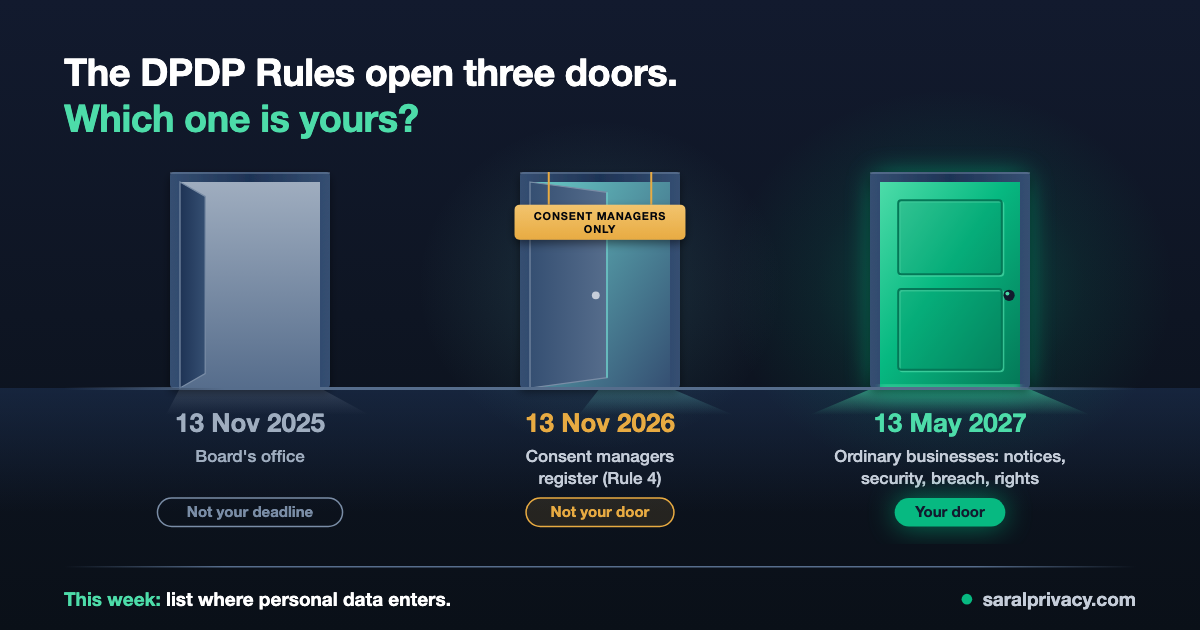
13 Nov 2026 starts consent manager registration under Rule 4, not your DPDP duties. See what starts, what waits until May 2027, and what to do now.
What happens to your business on Friday, 13 November 2026?
For most Indian businesses, nothing new becomes enforceable that day. The date is real, but it opens registration for consent managers under Rule 4. For a shop, a clinic, a factory, or an app, everyday DPDP duties begin on 13 May 2027.
So why is your phone full of "deadline" messages?
The forward that started it
Picture Meera (an illustrative example, not a real client). She runs a two-branch dental clinic in Pune. On Monday a forward lands in her clinic owners' WhatsApp group: "DPDP deadline 13 November. Are you ready?" By Tuesday, two vendors have called. Both say they can make her "DPDP-ready" before Friday.
Meera's worry is fair. Her clinic holds names, phone numbers, treatment notes, and payment records. She does not want to be the one who missed a date.
But the forward is using a real date for the wrong door. Most owners are reading 13 November the way Meera did.
Where it gets confusing
The phrase consent manager causes it.
In the Act, a consent manager is a specific, registered role. It is registered with the Data Protection Board and acts as a single point of contact, so a person can give, manage, review, and withdraw consent across different businesses on one platform.
A cookie banner on your own website is a different tool. The banner is a sticker on your own door. A consent manager is a name on the Board's register.
From the one-year mark, Rule 4 lets a company apply to the Board for registration. To qualify, the First Schedule asks for things such as:
- ✓being a company incorporated in India;
- ✓a net worth of at least ₹2 crore;
- ✓sufficient technical, operational, and financial capacity;
- ✓directors and senior managers with a reputation for fairness and integrity;
- ✓an independent certification of its platform against the standards the Board publishes.
The Board can register an applicant and publish its details on the Board's website. Once registered, the consent manager must follow the duties in Part B of the First Schedule, such as keeping records of consents and being unable to read the personal data that passes through it.
That is a registration window for a new kind of intermediary. Meera's clinic is not applying to be one.
A vendor becomes a consent manager when the Board's register says so.
Two traps this date sets
The wrong reading of 13 November pushes people one of two ways.
Trap 1: Panic-buying. A "deadline" is a strong sales line. Before you sign anything, ask what required task the product replaces. If the answer is "the 13 November deadline", ask again. If a vendor calls itself a consent manager, ask where the Board's website lists it. A name on a sales page is not a registration.
Trap 2: Relaxing because the day looks quiet. Friday comes and goes. Nothing visible happens for most businesses. It is tempting to mute the group and forget DPDP. But the May 2027 phase still arrives, and every month of waiting is a month less to map data, rewrite notices, and test breach response.
A quiet Friday is not a cancelled law.
Both traps eat into the months you have.
The real picture: one building, three doors
The DPDP Rules, 2025 were notified on 13 November 2025, and Rule 1 switches them on in three phases. Picture one building with three doors. Each door opens on a different day, for different people.
| Door | When it opens | Who it is for |
|---|---|---|
| Door 1 | On publication (13 November 2025) | The Board's own office. Rules 1 and 2 (title and definitions) and Rules 17 to 21, which deal with how the Data Protection Board is set up and works |
| Door 2 | One year later (13 November 2026) | Companies that want to register as consent managers. Rule 4 and the First Schedule |
| Door 3 | Eighteen months later (13 May 2027) | Ordinary businesses. Rule 3 and Rules 5 to 16, 22 and 23: notices, security safeguards, breach intimation, retention and erasure, children's data, Significant Data Fiduciaries, rights of data principals, cross-border transfers |
The forwards are crowding everyone at Door 2 and calling it theirs.
13 November opens a door for consent managers. Your door opens in May 2027.
What waits behind your door
A Data Fiduciary is the business that decides why and how personal data is used. Meera's clinic is one. So is a shop chain, an edtech app, or a manufacturer. For a typical Data Fiduciary, these duties begin with the May 2027 phase. They are not in force on 13 November 2026:
- ✓Notice content under Rule 3;
- ✓Security safeguards under Rule 6;
- ✓Breach intimation under Rule 7, including the detailed report to the Board within 72 hours;
- ✓Retention and erasure timing under Rule 8;
- ✓Children's data verification under Rule 10;
- ✓Rights handling under Rule 14;
- ✓the transfer rules in Rule 15.
The plain-English map of the Rules sits in our DPDP Rules, 2025 guide, and the short definitions sit in the glossary.
Who should still care about 13 November
Door 2 is not empty. Three groups have a real reason to watch it:
- ✓Companies that want to be consent managers. For them, 13 November is a start line. Eligibility needs evidence, and the Board decides who is registered.
- ✓Businesses in sectors where consent intermediaries are already familiar, such as lenders and insurers. You have nothing you must file that day. Watch who registers, and what connecting to one would involve. That is a product decision.
- ✓Anyone being sold software. "Consent manager" is a regulated label. A consent management platform (CMP) that you install on your site is a different, legitimate tool. Ask any vendor which one it is.
Meera's six-month runway
So what does Meera do instead of buying a tool on Thursday night? She works through one job a month until Door 3 opens.
- ✓Month 1: Find your data. List every place personal data enters: forms, apps, WhatsApp, billing, HR files, CCTV. Note who holds it and who else gets a copy.
- ✓Month 2: Fix your notices. Compare your privacy notice with Rule 3: itemised data, specific purposes, and a way to withdraw consent, use rights, and complain to the Board.
- ✓Month 3: Tidy consent. Separate "needed to deliver the service" from "optional extras", and make withdrawal as easy as agreeing.
- ✓Month 4: Lock down security. Check access control, logging, backups, and processor contracts against Rule 6.
- ✓Month 5: Rehearse a breach. Write the two messages Rule 7 asks for: one for affected people, one for the Board.
- ✓Month 6: Publish your contacts and rights process. Rule 9 asks for business contact details. Rule 14 asks you to publish how people can make requests, and your grievance response period.
This week, she does only month 1. For a clinic, that list is short and concrete: the appointment form, the WhatsApp number, the billing software, the staff files, the reception CCTV. That list is the whole of the first step.
For the full list of what a small business has to put in place, see DPDPA compliance requirements for Indian small businesses.
If you remember three things
- ✓13 November opens Door 2, for consent managers only.
- ✓Your door, Door 3, opens on 13 May 2027.
- ✓Find the data before you buy the tool.
If this cleared up the date for you, send it to one founder, one CA, or one ops lead who is still treating 13 November as a reason to buy software, or as a reason to wait.
FAQ
Do I have to register with the Data Protection Board on 13 November 2026? No. Registration under Rule 4 is for companies that want to operate as consent managers. Ordinary businesses do not register.
Do I have to use a consent manager? No. A person may choose to manage consent through one. The Act does not oblige a business to route consent through a consent manager.
Can penalties apply from 13 November 2026? No. Section 33 of the Act, which sets penalties, comes into force on 13 May 2027, together with the main business duties, such as notice (section 5), consent (section 6) and the general obligations in section 8.
Could the May 2027 date move? Possibly. Treat 13 May 2027 as the working date and check MeitY's notifications before you finalise your plan.
Not legal advice. This post is general information for Indian businesses. It is not legal advice. Check the Act, the Rules, and the Gazette, or ask a qualified lawyer, before you rely on it.
Not sure which door your business is standing at? Get a plain-English privacy readiness review from SaralPrivacy. We will map your data, score your gaps, and hand you the next three actions in writing.
Sources
- 1.Digital Personal Data Protection Rules, 2025, G.S.R. 846(E), Gazette of India Extraordinary No. 760, 13 November 2025, Rule 1[Gazette]
- 2.Digital Personal Data Protection Rules, 2025, Rule 4 and First Schedule, Parts A and B[Gazette]
- 3.G.S.R. 843(E), Ministry of Electronics and Information Technology, Gazette of India Extraordinary No. 757, 13 November 2025[Gazette]
- 4.Digital Personal Data Protection Act, 2023, sections 2(g), 6(7) and 6(9)[Gazette]
Get daily briefings by email
2-min reads, plain English, every morning. Free forever.
Need expert guidance?
Our team helps Indian businesses turn DPDPA readiness into a visible trust signal.
Get Consultation →