
Running data-principal rights under Rule 14: what to publish and how to answer
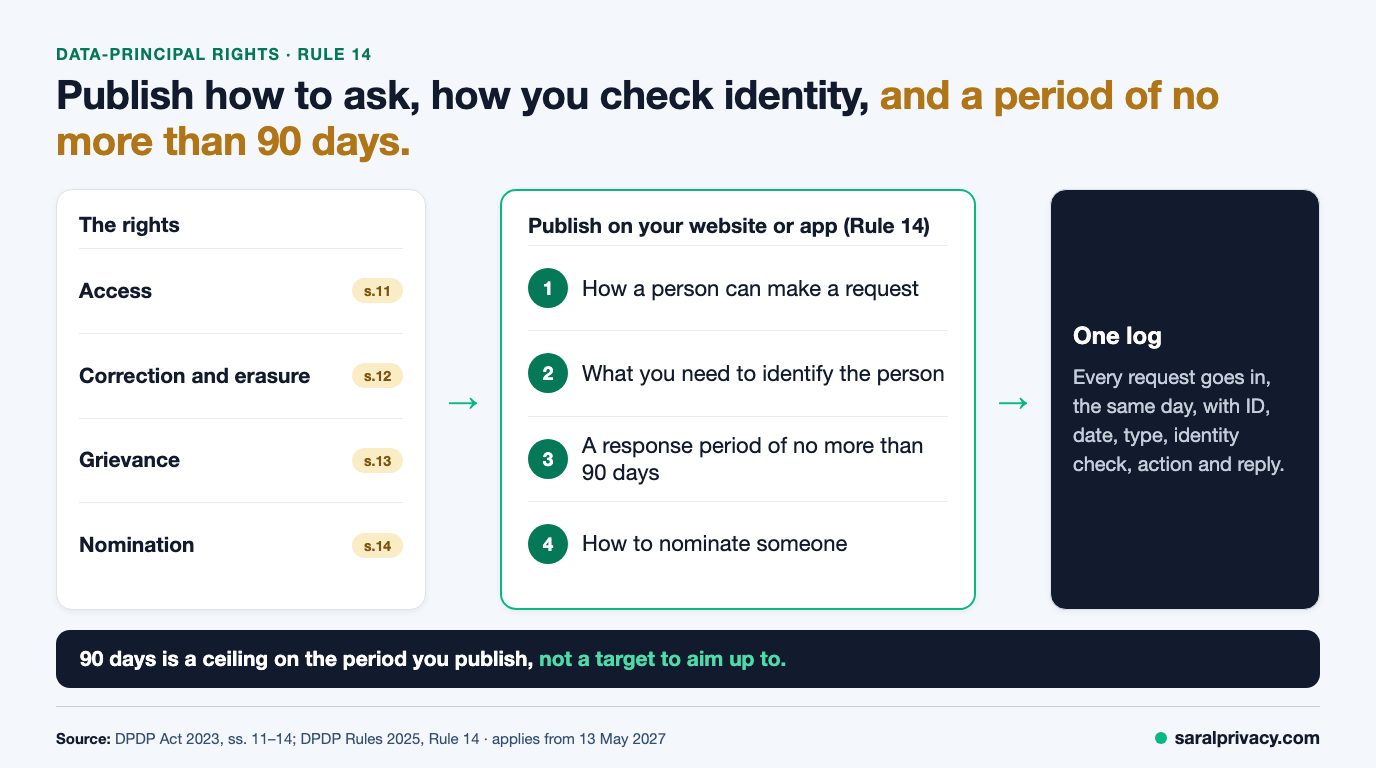
Rule 14 turns data-principal rights into a to-do list: what to publish, checking identity, the ninety-day ceiling, nominations and a request log.
TL;DR
- ✓Publish how to ask, how you check identity, and a period of no more than ninety days.
- ✓A shorter internal target is yours. It is not a deadline in the Rule.
- ✓A request that never reaches the log has no reply.
What does Rule 14 make a business publish, and how does a request get answered?
Rule 14 starts to apply on 13 May 2027. In plain terms it tells you to publish how a person can make a request, publish what you need to identify her, and publish a grievance response period that is reasonable and not more than ninety days. It also tells you to allow nominations. The rights themselves sit in the Act. They are access (section 11), correction and erasure (section 12), grievance redressal (section 13), and nomination (section 14).
The email will not wait for the page you meant to build.
The email in the founder's inbox
Picture Leela (an illustrative example, not a real client). She runs operations for a regional coaching chain. On a Wednesday the founder forwards an email from his personal account: "Please delete my daughter's data."
There is no "Your data rights" page. Support has no line for this. The SMS vendor has the parent's number on a marketing list. Fee records sit in billing, and a tax rule may require some of them to stay.
Leela's worry is fair. She wants to delete what can go, keep what a law requires, and reply with both facts. She also knows the next email may land with a branch counsellor, not with her.
Most requests arrive that way. The page you designed is the last place they show up.
The rights, before the machinery
| Right | Where in the Act | In plain English |
|---|---|---|
| Access to information | Section 11 | A summary of the personal data you process and what you do with it, and who you have shared it with |
| Correction, completion, updating and erasure | Section 12 | Fix wrong or incomplete data; erase it when it is no longer needed, unless a law requires you to keep it |
| Grievance redressal | Section 13 | A way to complain to you first |
| Nomination | Section 14 | Name someone to exercise rights if the person dies or cannot act |
People also have duties under section 15, such as not registering a false or frivolous grievance or complaint. Those duties do not shrink yours. They are context when you handle a request.
The fuller map of the rights sits on the rights page.
What Rule 14 asks you to publish
- ✓How a person can make a request. The means must be easy to find on your website or app.
- ✓What you need to identify her. For example, the username or account email you rely on under your terms of service.
- ✓A response period in your grievance system. The period must be reasonable and not more than ninety days, and you must have measures so the system works within it.
- ✓Nominations. A person can nominate one or more people to exercise her rights, in line with your terms of service and applicable law.
Rule 9 adds a related duty: publish the business contact of your Data Protection Officer, or of another person who can answer questions about processing, and include that contact in every reply to a rights request.
Ninety days is a ceiling on the period you publish. It is not a target to aim up to.
Two traps the ninety days sets
You will see other numbers online: 48 hours, 7 days, 30 days. The Rule itself speaks of a published period of no more than ninety days.
Trap 1: You publish 48 hours because a blog used that number. A promise on the website that you cannot keep is a problem of its own. If you set a shorter service goal inside the team, label it as your target, not as a deadline in the Rule.
Trap 2: You quote ninety days and let the email sit. The Act expects the person to use your grievance route first. If she is not satisfied, she can approach the Board. A logged, reasoned reply is what you will have if that happens. An email that never reached a log is not a reply.
One door, then the log
Step 1: Make a front door. One page, "Your data rights", linked from the footer and the privacy notice. Offer at least one channel your customers will use: an in-app form, an email address, or both. If you serve people with limited internet access, add a phone or branch option.
Step 2: Decide how you check identity. Use what you already hold. A request from inside a logged-in account is easy to trust. A request by email can be confirmed with the registered mobile number or email. Do not ask for new documents you do not otherwise need. Collecting more data to answer a request works against the request.
Step 3: Name an owner. One person, or a small team, receives requests, assigns them and replies. Name a backup. Their contact goes on the page.
Step 4: Write a short path for each type. Access, correction, erasure, grievance, nomination. Note which systems each one touches: CRM, billing, marketing tools, backups, processors.
Step 5: Add the processors. Your vendors hold data too. Ask each how they will help you find, correct or delete data, and how quickly. You remain responsible. Pass the request on, and track it.
Step 6: Log every request. The log is your evidence if a complaint reaches the Board.
| Field | Example |
|---|---|
| Request ID | R-2027-014 |
| Date received and channel | 3 June 2027, web form |
| Type | Erasure |
| Identity checked how | OTP to registered number |
| Systems searched | CRM, billing, email tool |
| Action taken | Deleted from CRM and email; billing retained for tax records |
| Date and content of reply | 12 June 2027; explained retained items |
| Closed | Yes |
| Escalated to grievance? | No |
Terms sit in the glossary.
What Leela does with the daughter's email
- ✓She replies asking the parent to confirm from the registered phone number.
- ✓She notes that the student is under 18, so the chain deals with the parent.
- ✓She checks which records the chain must keep for fees and accounts, and which can go.
- ✓She deletes the rest from the CRM, the marketing list and the app, and asks the SMS vendor to do the same.
- ✓She replies with what was deleted, what was kept and why, and she includes the contact for questions.
The line for everyone else
Rights requests come to support agents, sales reps, branch staff, and sometimes to the founder's personal email. Give everyone one instruction: "If someone asks about their data, forward it to the rights desk the same day, and tell them it has been logged."
Add a short training session and a reminder in the support tool. Test it by sending a dummy request to a random team member each quarter, and measure how long it takes to reach the log. A fast hand-off is what makes any published response period believable.
This week, Leela does only the naming. She picks the owner and the backup, writes their names on the future page, and sends the one forwarding line to branch staff. The page, the scripts and the first dummy test come after the owner exists.
If you remember three things
- ✓Publish how to ask, how you check identity, and a period of no more than ninety days.
- ✓A shorter internal target is yours. It is not a deadline in the Rule.
- ✓A request that never reaches the log has no reply.
Forward it the same day. Then it exists.
If this gave your front line a sentence, send it to one founder, one branch manager, or one support lead who still answers "delete my data" from a personal inbox with no log.
FAQ
Is ninety days the deadline for every request? Rule 14 speaks of the response period you publish in your grievance redressal system, which must not exceed ninety days. Check the Rules and the Act for how this applies to each type of request before you set your published period.
Can I charge a fee? Neither the Act nor the Rule, as we read them, sets a fee. Check before you add one.
Can I refuse an erasure request? You may need to keep data where a law requires it, or where it is still needed for the purpose it was collected. Explain this in your reply.
What if my vendor holds the data? You remain responsible. Pass the request on and track it.
Not legal advice. This post is general information for Indian businesses. It is not legal advice. Check the Act, the Rules and the Gazette, or ask a qualified lawyer, before you rely on it.
Not sure where a rights request would land in your business tomorrow? Get a plain-English privacy readiness review from SaralPrivacy. We will map your data, score your gaps, and hand you the next three actions in writing.
Sources
- 1.Digital Personal Data Protection Rules, 2025, G.S.R. 846(E), Rule 14[Gazette]
- 2.Digital Personal Data Protection Act, 2023, sections 11, 12, 13 and 14[Gazette]
- 3.Digital Personal Data Protection Rules, 2025, Rule 9[Gazette]
- 4.DPDP Rules, 2025, Rule 1(4)[Gazette]
Get daily briefings by email
2-min reads, plain English, every morning. Free forever.
Need expert guidance?
Our team helps Indian businesses turn DPDPA readiness into a visible trust signal.
Get Consultation →