
The 15-point DPDP checklist for Indian businesses
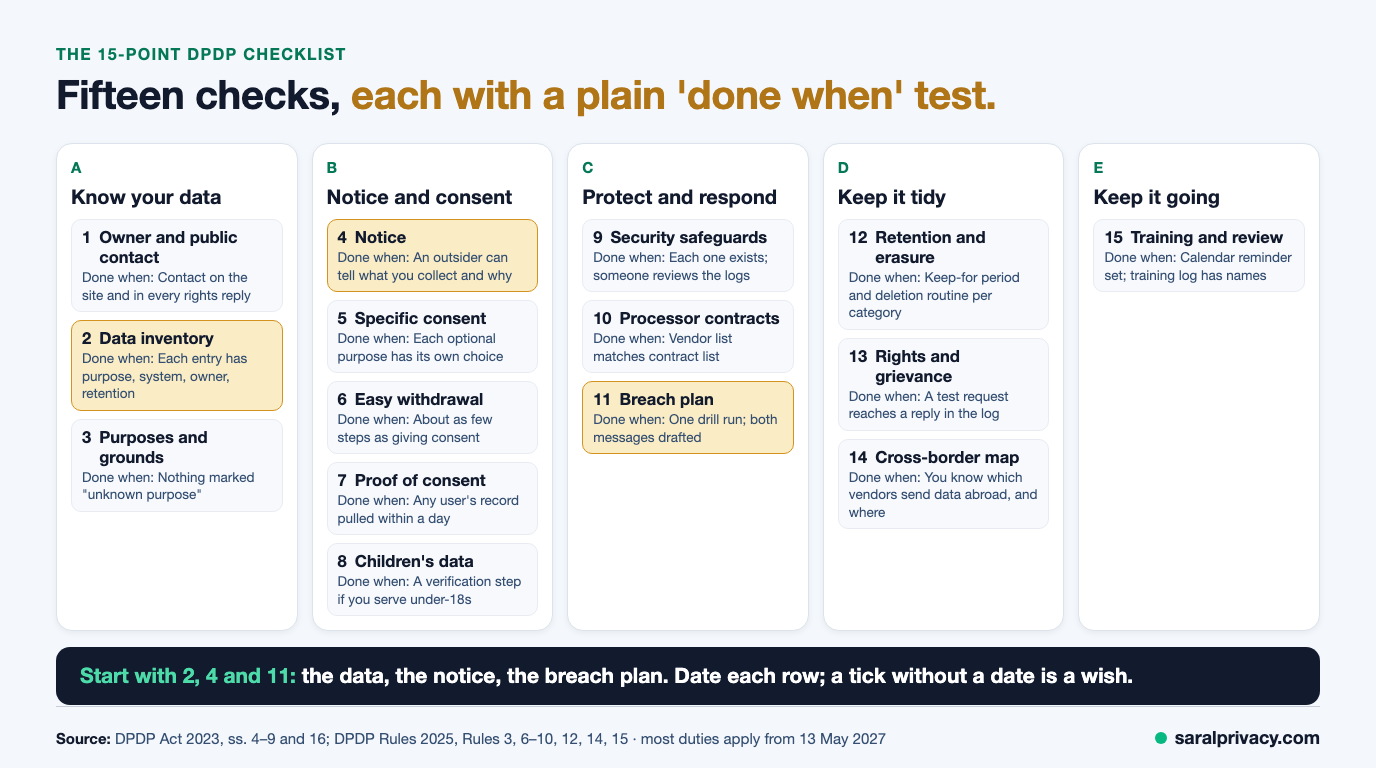
A 15-point DPDP checklist for Indian businesses, each with a clear 'done when' test, the Rule it relates to, and a one-page printable version.
TL;DR
- ✓Fifteen items, each with a done-when line.
- ✓Items 2, 4 and 11 pay off first: the data, the notice, and a breach plan.
- ✓A one-person business can do this with a spreadsheet, a short notice and a one-page plan.
Which checks tell you a DPDP file is finished?
Fifteen. Each one below has a plain test for when it is done. Most of these duties start for ordinary businesses on 13 May 2027. Starting now means you finish with time to spare. A small business with a few systems can usually get through items 1 to 7 in a month. Items 9 to 14 take longer, because they depend on vendors and engineering.
A 60-page report can sit in a drawer and still fail every test.
The report in the drawer
Picture Priya (an illustrative example, not a real client). She runs a one-location diagnostic lab in Indore. Patient names, phone numbers, reports and a reception camera are the data she already holds. A consultant leaves a 60-page pack on the reception desk. The last page says the lab should "achieve readiness". No item says who does it, or how Priya will know it is done.
Priya's worry is fair. She will not read sixty pages between sample collections. She needs a list she can tick, with a date, and an owner who is not the consultant.
Most owners file the pack and feel finished. The pack described the work. It did not do it.
A report you cannot tick is a report you have not started.
Two traps the pack sets
Trap 1: The drawer counts as progress. Nobody outside the team can tell what you collect, or how a person withdraws. The duties have not moved.
Trap 2: All fifteen boxes get a tick on Sunday night. Items that depend on a vendor contract or an engineering change cannot be finished in a weekend. A dated note that says "not started, owner named" is a truer record than a tick with no proof. Do not aim for a perfect file on day one. Aim for a visible, dated record of progress.
A. Know your data
1. Name an owner and publish a contact (Rule 9). Choose one accountable person and a backup. Publish business contact details of someone who can answer questions about your processing. Done when: the contact is on your website or app and in every reply to a rights request.
2. Build a data inventory. List every place personal data is collected and stored: forms, apps, WhatsApp, billing, HR files, CCTV, vendor dashboards. Done when: each entry has a purpose, a system, an owner and a retention period.
3. Write down your purposes and the ground for each. For every use of data, note whether it rests on consent or on one of the section 7 "legitimate uses". Done when: nothing in the inventory is marked "unknown purpose".
B. Notice and consent
4. Fix your notice (Rule 3). It must be clear, stand on its own, itemise the data and the specific purposes, describe what that use of data supports, and say how to withdraw consent, use rights and complain to the Board. Done when: someone outside your team can read it and tell you what you collect and why.
5. Make consent specific. Separate "needed to deliver the service" from optional extras. No pre-ticked boxes, no bundling. Done when: each optional purpose has its own choice.
6. Make withdrawal as easy as agreeing (section 6(4)). Done when: a test user can withdraw in the same place and in about as few steps as it took to consent.
7. Keep proof of consent (section 6(10)). Record who agreed, to which purpose, under which version of the notice, when, and through which channel. Done when: you can pull a record for any user within a day.
8. Handle children's data properly (section 9, Rules 10 and 12). If you serve anyone under 18, you need verifiable consent from a parent or guardian, and the Act bars tracking, behavioural monitoring and targeted advertising aimed at children, subject to the exemptions in the Fourth Schedule. Done when: you know whether you handle child data and have a verification step if you do.
C. Protect and respond
9. Put reasonable security safeguards in place (Rule 6). Encryption or masking where suitable, access controls, logs and monitoring, backups, and processor contracts. Done when: you can show each of these exists, and who reviews the logs.
10. Sign proper contracts with processors. Every vendor that handles personal data for you needs a contract covering purpose, security, breach alerts and deletion. Done when: your vendor list matches your contract list.
11. Write and drill a breach plan (Rule 7). On becoming aware of a breach you must tell affected people and the Board without delay, and give the Board fuller details within 72 hours, or longer if the Board allows on written request. Done when: you have run one drill and have both messages drafted.
D. Keep it tidy
12. Set retention and erasure rules (section 8(7), Rule 8). Keep data only as long as its purpose needs, unless a law requires more. Rule 8(3) also sets a floor: keep personal data, traffic data and processing logs for at least one year. Large e-commerce, gaming and social media platforms have a three-year period in the Third Schedule, and must warn users at least 48 hours before erasure. Done when: each data category has a keep-for period and a deletion routine.
13. Run a rights and grievance process (Rule 14). Publish how people can make requests, what you need to identify them, your response period (no more than ninety days), and how to nominate someone. Done when: a test request goes from receipt to a reply in your log.
14. Map cross-border flows (section 16, Rule 15). Done when: you know which vendors send data outside India and where.
E. Keep it going
15. Train and review. Short sessions for sales, HR, finance and support. A review every quarter. A watch on Board and MeitY notices. If you are notified as a Significant Data Fiduciary, add the extra duties in section 10 and Rule 13: a Data Protection Officer, an independent auditor, a yearly impact assessment and audit, and due-diligence checks on algorithms. Done when: a calendar reminder exists and the training log has names.
Items 2, 4 and 11 pay off fastest: knowing your data, fixing the notice, and having a breach plan. The Rules in plain English are in the walkthrough. A smaller-business path through the same duties is the SME guide. The dates sit in What 13 November 2026 actually starts. Terms sit in the glossary. The long version is the DPDPA guide.
What Priya does this week
She prints the one-page table. She writes her own name as owner on item 1, and her lab manager as backup. She starts item 2 with four rows she can see from the reception desk: the appointment register, the WhatsApp number patients already message, the billing software, and the reception camera. She does not tick them. She dates the sheet.
A one-person business still carries the duties. The tools can stay small. A spreadsheet, a short notice and a one-page plan are enough.
The one-page printable
| ☐ | Item | Rule or section | Owner | Date |
|---|---|---|---|---|
| ☐ | 1 Owner and public contact | Rule 9 | ||
| ☐ | 2 Data inventory | – | ||
| ☐ | 3 Purposes and grounds | ss. 4, 6, 7 | ||
| ☐ | 4 Notice | s. 5, Rule 3 | ||
| ☐ | 5 Specific consent | s. 6 | ||
| ☐ | 6 Easy withdrawal | s. 6(4) | ||
| ☐ | 7 Proof of consent | s. 6(10) | ||
| ☐ | 8 Children's data | s. 9, Rules 10, 12 | ||
| ☐ | 9 Security safeguards | Rule 6 | ||
| ☐ | 10 Processor contracts | s. 8(2) | ||
| ☐ | 11 Breach plan | s. 8(6), Rule 7 | ||
| ☐ | 12 Retention and erasure | s. 8(7), Rule 8 | ||
| ☐ | 13 Rights and grievance | ss. 11 to 14, Rule 14 | ||
| ☐ | 14 Cross-border map | s. 16, Rule 15 | ||
| ☐ | 15 Training and review | – |
If you remember three things
- ✓Fifteen items, each with a done-when line.
- ✓Items 2, 4 and 11 pay off first: the data, the notice, and a breach plan.
- ✓A one-person business can do this with a spreadsheet, a short notice and a one-page plan.
Date the row. A tick without a date is a wish.
If this replaced a report nobody will read, send it to one founder, one CA, or one ops lead who still has a privacy pack in a drawer and no owner on page one.
FAQ
Is this checklist enough for full compliance? It covers the main duties most businesses meet first. Sector rules and special categories (like Significant Data Fiduciaries) add more.
Which items are most urgent? Items 2, 4 and 11 pay off fastest: knowing your data, fixing the notice and having a breach plan.
Do I need all fifteen if I'm a one-person business? You still carry the duties, but you can meet them with very simple tools: a spreadsheet, a short notice and a one-page plan.
Where do I find the Rules? Read the notified Rules in the Gazette, or our plain-English walkthrough.
Not legal advice. This post is general information for Indian businesses. It is not legal advice. Check the Act, the Rules and the Gazette, or ask a qualified lawyer, before you rely on it.
Not sure which of the fifteen rows you can finish this month? Get a plain-English privacy readiness review from SaralPrivacy. We will map your data, score your gaps, and hand you the next three actions in writing.
Sources
- 1.Digital Personal Data Protection Rules, 2025, G.S.R. 846(E), Rules 3, 6, 7, 8, 9, 10, 12, 14 and 15[Gazette]
- 2.Digital Personal Data Protection Act, 2023, sections 4 to 9 and 16[Gazette]
- 3.Digital Personal Data Protection Rules, 2025, Rule 8 and Third Schedule[Gazette]
- 4.Digital Personal Data Protection Act, 2023, section 10; DPDP Rules, 2025, Rule 13[Gazette]
Get daily briefings by email
2-min reads, plain English, every morning. Free forever.
Need expert guidance?
Our team helps Indian businesses turn DPDPA readiness into a visible trust signal.
Get Consultation →