
Do you need a consent manager? Busting the 'mandatory' myth
Is a consent manager mandatory under DPDP? No. Where the myth comes from, what you must do instead, a five-question test and a script for vendor pitches.
TL;DR
- ✓A business is not required to route consent through a consent manager.
- ✓Notice, consent, withdrawal, proof and rights still have to work.
- ✓Ask for the section, and for the Board register entry, before you pay.
Does the DPDP Act require your business to connect to a consent manager?
No. No provision of the Act or the Rules requires a business to route consent through a consent manager. Section 6(7), which starts on 13 May 2027, gives a person the option to give, manage, review and withdraw consent through one. Rule 4, in force since 13 November 2026, sets out how a company can register to be one. Neither obliges your business to use one.
The sales call still says you must. That is the claim worth slowing down for.
The call in Surat
Picture Sameer (an illustrative example, not a real client). He runs a recruitment agency in Surat. Candidates send CVs on the website, on WhatsApp, and across the front desk. On Tuesday a vendor tells him he needs to integrate with a consent manager "to be DPDP-compliant", and that the window is closing.
Sameer's worry is fair. A large client has started asking how the agency records consent. He does not want to fail that question, and he does not want to buy a pipe he is not required to lay.
Most owners on that call hear "mandatory" and reach for the contract. The Act, on this point, says "may".
Where the word mandatory comes from
Three things get mixed together:
- ✓A new regulated role. The Act and Rule 4 create the consent manager, with registration and detailed duties. A quick reader sees a lot of obligations and assumes they apply to every business.
- ✓Two different groups. Rule 4's conditions apply to companies that want to operate as consent managers. They do not apply to a business deciding whether to connect to one.
- ✓A reason to sell. Vendors selling consent products have a reason to make "consent manager" sound like a box you must tick. The side-by-side is in Cookie-banner tool vs DPDP consent manager.
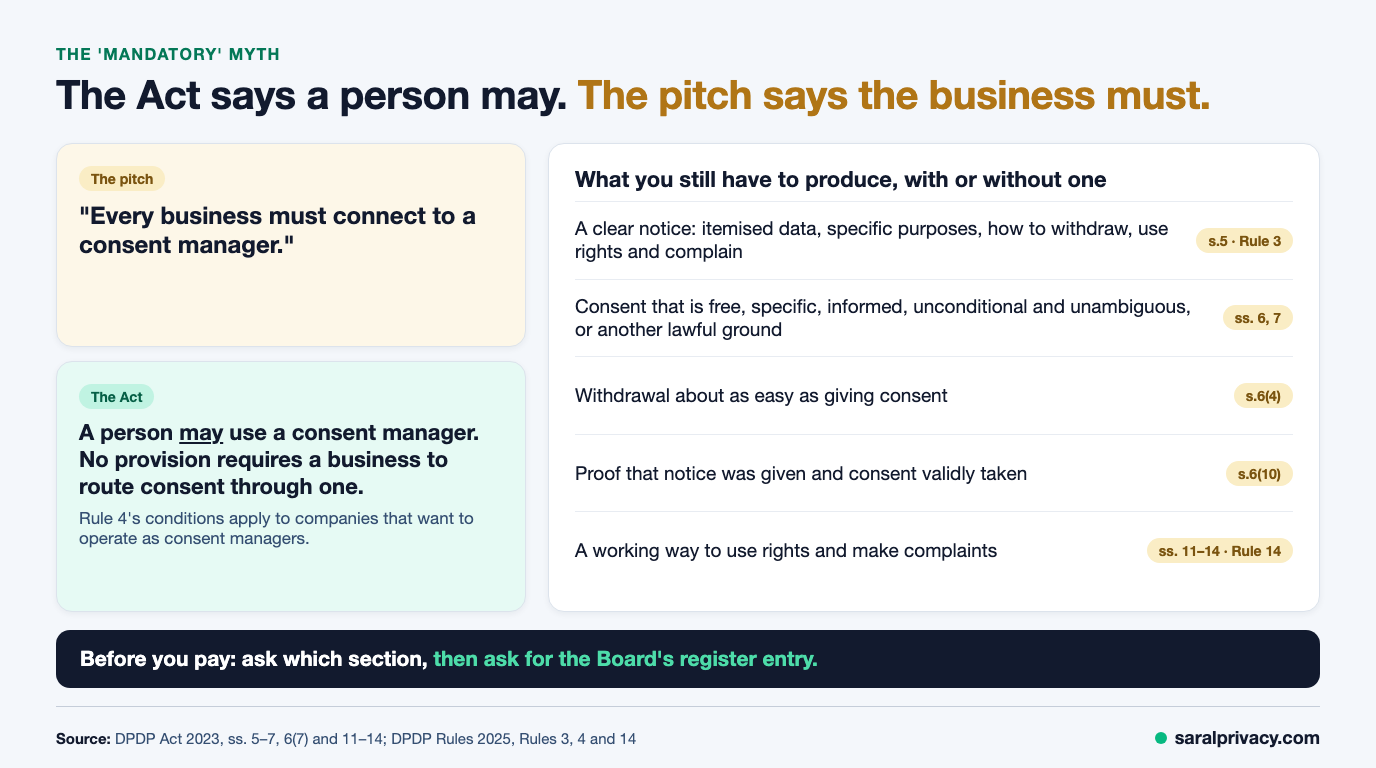
The Act says a person may. The pitch says the business must.
What you still have to produce
Whichever route you use, the consent process has to produce these outcomes:
| Outcome | Where it comes from |
|---|---|
| A clear notice with itemised data, specific purposes and how to withdraw, use rights and complain | Section 5 and Rule 3 |
| Consent that is free, specific, informed, unconditional and unambiguous, or another lawful ground | Sections 6 and 7 |
| Withdrawal that is about as easy as giving consent | Section 6(4) |
| Proof that you gave notice and got valid consent | Section 6(10) |
| A working way to use rights and make complaints | Sections 11 to 14 and Rule 14 |
You can meet every row by dealing with candidates and clients directly. A consent manager is a route, not a requirement.
Two traps the call sets
Trap 1: You pay for an integration the Act did not ask for. Time and budget go to the intermediary. The notice, the retention rules and the breach basics stay unfixed. "We have a consent manager" is not an answer if the notice is vague or the withdrawal path is broken.
Trap 2: You hang up, and you also skip the table. Refusing the pitch does not write the notice, record the choice, or test withdrawal on the website, the app, WhatsApp, the paper form, and the front desk.
A consent manager can still be a sensible product choice if you run many touchpoints and want people to manage them in one place, if you work in a sector where consent-based data sharing is already familiar, such as lending or insurance, if customers ask, or if you want to reduce your own tracking work and you are comfortable relying on an external, regulated party. Even then it adds a dependency: your systems must be ready to receive instructions from outside, and your contracts must say who does what. That readiness is in what changes when the first consent manager goes live.
Sameer's five questions, before any money
- ✓Does any law or regulator I am subject to say I must connect to one? Check the sector regulator's current text, not a vendor's summary.
- ✓Can I already show notice, consent, withdrawal and records without one?
- ✓Do my customers or partners expect it?
- ✓Is the proposed provider on the Board's register of consent managers?
- ✓Could I walk away, and what happens to my records if I do?
If the answer to question 1 is no and the answer to question 2 is yes, nothing in the Act or the Rules makes you connect. The rest is a business decision.
On the call, Sameer can read this:
"Which provision of the Act or the Rules requires us to connect to a consent manager? Please show me the Board's register entry for your company. If you are selling a consent management platform rather than a registered consent manager, tell me what duties it covers and what it leaves to us."
A straight answer is a useful sign. A vague reference to "the deadline" is not. How to judge the platform, if that is what they are selling, is in how to choose a consent platform.
If a customer asks you to connect
A large customer, a bank partner or a platform may ask you to integrate with one named consent manager. Treat that as a commercial request, not a legal order. Ask who the consent manager is, whether it appears on the Board's register, what you would have to build, what it costs, and what happens to your records if the arrangement ends. You can say yes, no, or not yet. Record the reasoning and the date, so a later reader can see the decision.
What Sameer does this week
- ✓List how people give consent today: web, app, WhatsApp, forms, in person.
- ✓Check that each route shows a notice and records the choice.
- ✓Test withdrawal once for each route.
- ✓Add "consent manager" to a watch list: look at the Board's register now and then.
- ✓Keep the vendor pitch, and the reply, on file.
This week he does item 1, and he tests withdrawal once, on the website form only. The other routes wait until that one path is written down. Terms sit in the glossary.
If you remember three things
- ✓A business is not required to route consent through a consent manager.
- ✓Notice, consent, withdrawal, proof and rights still have to work.
- ✓Ask for the section, and for the Board register entry, before you pay.
Ask which section, then ask for the register entry.
If this gave you a sentence for the next sales call, send it to one founder, one CA, or one ops lead who was told a consent manager is mandatory.
FAQ
Is a consent manager the same as a cookie banner? No. A banner is software for your own site. A consent manager is a registered company that works for the person.
Do banks or lenders have to use one? We are not aware of a general rule saying so in the Act or the Rules. Check your sector regulator's current directions.
If I don't use one, am I less compliant? No, if you meet the notice, consent, withdrawal, records and rights duties directly.
Can a customer insist I accept her consent manager? From 13 May 2027 the Act lets a person use one. Neither the Act nor the Rules spells out how a business that has not joined must handle a withdrawal sent that way, so watch for Board guidance. Plan to accept it.
Not legal advice. This post is general information for Indian businesses. It is not legal advice. Check the Act, the Rules and the Gazette, or ask a qualified lawyer, before you rely on it.
Not sure whether the call you took was a legal duty or a product pitch? Get a plain-English privacy readiness review from SaralPrivacy. We will map your data, score your gaps, and hand you the next three actions in writing.
Sources
- 1.Digital Personal Data Protection Act, 2023, section 6(7)[Gazette]
- 2.Digital Personal Data Protection Rules, 2025, G.S.R. 846(E), Rule 4 and First Schedule[Gazette]
- 3.Digital Personal Data Protection Act, 2023, sections 5, 6, 7 and 11 to 14; DPDP Rules, 2025, Rules 3 and 14[Gazette]
- 4.DPDP Rules, 2025, Rule 1; G.S.R. 843(E), 13 November 2025[Gazette]
Get daily briefings by email
2-min reads, plain English, every morning. Free forever.
Need expert guidance?
Our team helps Indian businesses turn DPDPA readiness into a visible trust signal.
Get Consultation →