
Breach notification kit: ready-to-adapt notices for the Board and for affected people
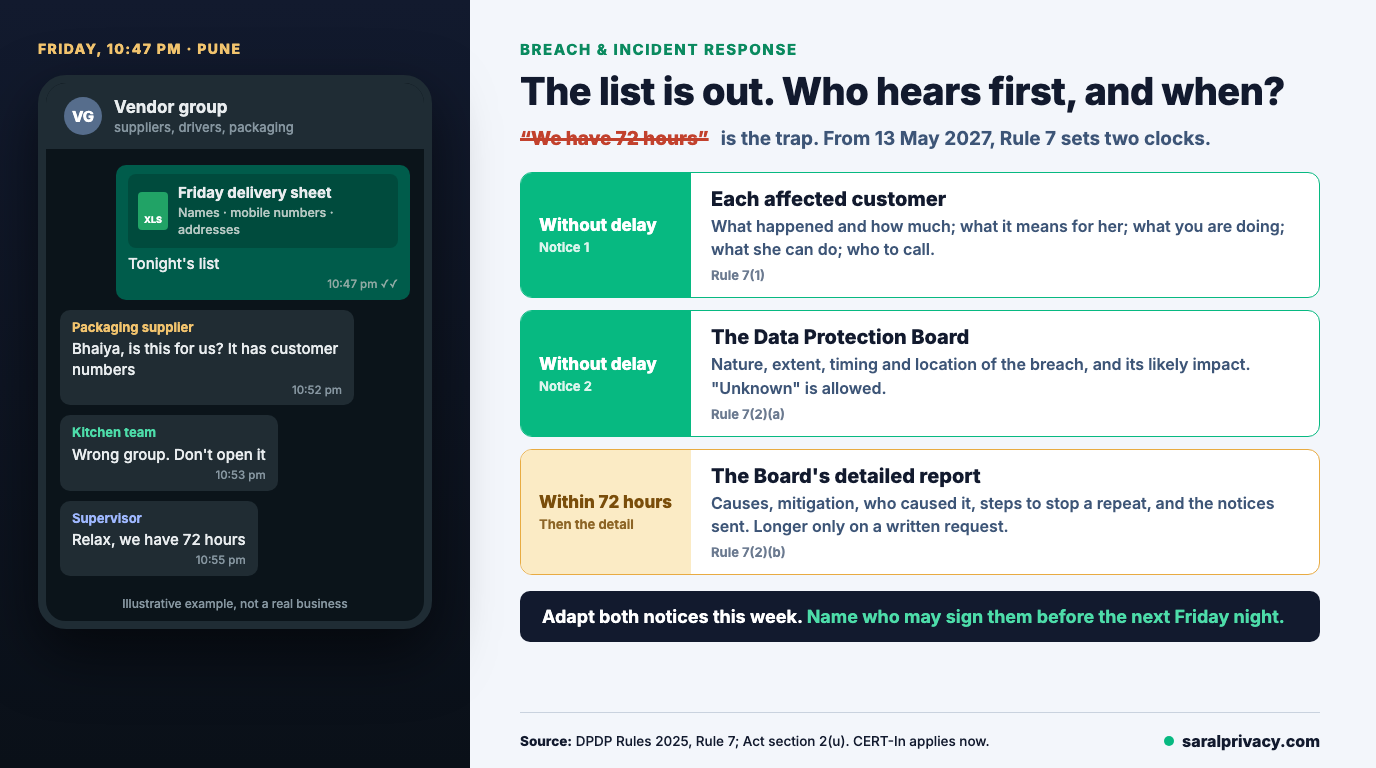
Breach notification kit for India: plain-language templates for affected people and the Data Protection Board under Rule 7, a fact checklist and a 72-hour work plan.
TL;DR
- ✓Tell each affected person and the Board without delay. The 72 hours is for the detailed report to the Board.
- ✓Write unknown where a fact is missing. Do not guess.
- ✓If the detailed report will not be ready, ask the Board in writing for a longer period. Send the request before the 72 hours are up.
If customer names and phone numbers leave the kitchen tonight, which note goes out first, and to whom?
Two notes, on different clocks. When you become aware of a personal data breach, Rule 7 asks you to tell each affected person without delay, and to tell the Data Protection Board without delay. Within 72 hours of becoming aware, you send the Board updated and detailed information, or later if the Board allows a longer period after a written request. Rule 7 starts on 13 May 2027. CERT-In's reporting directions already apply. The worst time to start drafting is during the breach.
"We have 72 hours to tell customers" is the sentence that sends the wrong note.
The sheet that left the kitchen
Picture Sheetal (an illustrative example, not a real client). She runs a cloud kitchen in Pune. Orders carry names, mobile numbers, and delivery addresses. On a Friday night a supervisor forwards the evening delivery sheet to a vendor WhatsApp group. It is the wrong group. The sheet is still sitting there while the team argues about how many flats are on it.
Someone says they should wait until every name is confirmed. Someone else says the team has 72 hours before anyone outside needs a message. Sheetal wants a page she can fill in with the words "unknown" still allowed.
Two traps the kit is built to avoid
Trap 1: Wait for all the facts before telling anyone. The first notices go without delay. Rough numbers are fine at first. A later report carries the detail.
Trap 2: Treat the 72 hours as the deadline for telling people. The 72 hours is for the detailed report to the Board. It is not the deadline for telling people. Affected people are told without delay. The Board is told without delay. See Two clocks, two regulators.
What Rule 7 asks for, in short
When you become aware of a personal data breach:
- ✓Tell each affected person without delay, in clear and plain language, through her user account or another registered way of reaching her. The message must cover what happened (its nature, extent and timing), the likely consequences for her, what you have done to limit harm, what she can do to protect herself, and a business contact for questions.
- ✓Tell the Board without delay: the nature, extent, timing and location of the breach, and its likely impact.
- ✓Within 72 hours of becoming aware, send the Board updated and detailed information: the broad facts of the events, circumstances and reasons that led to the breach, the mitigation, findings about who caused it (if known), the steps to stop it recurring, and a report on what you told affected people. The Board can allow a longer period if you ask in writing.
Tell people without delay. The 72 hours belongs to the Board's detailed report.
Step 1: Collect the facts
Fill in this checklist as fast as you can. Write "unknown" where you must; don't guess.
- ✓When did we first notice, and who did?
- ✓When did a person with authority become aware? The Rule does not say whose awareness counts, so count your clocks from the first notice.
- ✓What systems are involved?
- ✓What kinds of data (contact details, identity numbers, financial, health, passwords)?
- ✓How many people, and where do they live? Rough numbers are fine at first.
- ✓Is it still happening? What have we stopped or contained?
- ✓What is the likely harm (fraud, phishing, exposure of sensitive facts)?
- ✓Who might be responsible, if known?
- ✓Which other regulators or partners must be told (CERT-In, your sector regulator, contract partners)?
The wider topic is the breach response guide. Terms sit in the glossary.
Step 2: Template for affected people
The templates below are examples to adapt. Have your lawyer read your final version before you rely on it.
Keep it short, human and specific. Adapt the brackets.
Subject: Important: a security incident involving your information
Dear [Name],
We are writing to tell you about a security incident that affected some of the information we hold about you.
What happened. On [date], we found that [plain description, for example: "an unauthorised person gained access to a system that stores customer account details"]. The access took place between [start] and [end, or "is now stopped"]. [Extent: how many people and records are affected, or "we are still counting".]
What information was involved. [List: for example, your name, mobile number and delivery address.] [State clearly what was not involved, if you know: for example, "your payment card details were not stored in this system".]
What this could mean for you. [Plain consequences: for example, "you may receive calls or messages from people pretending to be us".]
What we have done. [Steps taken: closed the access, reset passwords, engaged specialists, informed the authorities.]
What you can do. [Specific steps: do not share OTPs with anyone; be careful with messages that ask for money or personal details; change your password; contact your bank if needed.]
Questions. Please contact [name or role] at [email] or [phone]. [Days and hours this contact is answered.]
We are sorry this happened and will tell you if we learn anything that changes this message.
[Business name]
Send it through the account or contact method the person registered with you. Keep a copy and a list of who got it, and when.
If software helps you prepare that note, a person still has to own the judgement.
Step 3: Template for the Board
When we checked the Board's website on 22 November 2026, we found no prescribed form for breach notices. Check again before you use this. Until a form exists, a structured document like this can carry the first notice. Its rows cover the Rule 7(2)(a) items:
| Section | What to write |
|---|---|
| Reporting entity | Legal name, address, contact person, and the contact required under Rule 9 |
| Incident reference and dates | Your internal ID; time first noticed; time of awareness |
| Summary | Nature, extent, timing and location of the breach, in plain language |
| Data affected | Categories of personal data and estimated number of people |
| Likely impact | What harm could follow |
| Measures taken | Containment and mitigation so far |
| Notice to people | Whether and how affected people were told, with date |
| Other notifications | CERT-In or other regulators, if any |
| Next steps | When you will send the detailed report |
Step 4: The detailed report (within 72 hours)
Extend the table above with:
- ✓the broad facts of the events, circumstances and reasons that led to the breach, with a timeline;
- ✓the mitigation carried out;
- ✓findings about who caused the breach, if known;
- ✓the remedial steps to prevent a repeat;
- ✓a report on the notices sent to affected people, including the wording, the channel, the date and any people you couldn't reach.
If you won't be ready in time, ask the Board in writing for a longer period. The Rule sets no deadline for that request. Our advice is to send it before the 72 hours are up.
A simple schedule
| When | Action |
|---|---|
| Hour 0 | Record awareness time; contain; assemble the response team |
| First hours | Draft both notices; check CERT-In and sector timings |
| Without delay | Send people's notices and the Board's first notice |
| Hours 24 to 60 | Gather detail; prepare the report; ask for more time if needed |
| By hour 72 | Send the detailed report |
| After | Fix root causes; update logs, register and training |
The row that says "without delay" is the customer note and the Board's first notice. The row that says "by hour 72" is the detailed report to the Board.
Common mistakes
- ✓Waiting for "all the facts" before telling anyone.
- ✓Using legal or technical language that people can't follow.
- ✓Promising "no harm" when you don't know.
- ✓Forgetting the account holders who have no working contact on file.
- ✓Not keeping proof of what was sent.
What Sheetal sets up this week
She does this while the pass is quiet, not on a Friday night.
- ✓She copies both templates into a folder the shift lead can open.
- ✓She fills the brackets that do not change: business name, the questions contact, and the hours that inbox is watched.
- ✓She writes "unknown" in pencil beside every fact the team will not have in the first hour, so nobody feels they must invent a number.
- ✓She names who may sign. In her kitchen, that is her, with the supervisor as deputy.
- ✓She checks that customer phone numbers on the order system are the numbers people actually registered.
This week the only finished page is the pair of templates with the fixed lines filled in, and the name of the person who may sign.
If you remember three things
Same three lines as the top.
- ✓Tell each affected person and the Board without delay. The 72 hours is for the detailed report to the Board.
- ✓Write unknown where a fact is missing. Do not guess.
- ✓If the detailed report will not be ready, ask the Board in writing for a longer period. Send the request before the 72 hours are up.
Draft the notes before the sheet leaves the kitchen.
If this split the customer note from the 72-hour Board report, send it to one founder, one CA, or one ops lead who would wait for a complete list of names before telling anyone.
FAQ
Do I notify for every incident? For every personal data breach, yes. Section 2(u) defines it: any unauthorised processing of personal data, or accidental disclosure, acquisition, sharing, use, alteration, destruction or loss of access to it, that compromises its confidentiality, integrity or availability. Rule 7 adds no test of risk or size. Log every incident, including ones that do not meet the definition, with the reasons.
The Board's website says to tell people if there is a risk. Which do I follow? The Rule. Rule 7(1) asks you to tell each affected person, with no risk threshold.
Can the Board's notice be a phone call? Don't rely on that. Send a written notice and keep a copy.
Who signs the notice? A person with authority in the organisation, usually the incident lead or the head of legal or compliance.
Should the notice mention the penalty? No. Describe the facts, the effects and the help you offer.
Not legal advice. This post is general information for Indian businesses. It is not legal advice. Check the Act, the Rules and the Gazette, or ask a qualified lawyer, before you rely on it.
Not sure what to do first? Get a plain-English privacy readiness review from SaralPrivacy. We will map your data, score your gaps, and hand you the next three actions in writing.
Sources
- 1.Digital Personal Data Protection Rules, 2025, G.S.R. 846(E), Rule 7(1)[Gazette]
- 2.DPDP Rules, 2025, Rule 7(2)[Gazette]
- 3.Digital Personal Data Protection Act, 2023, sections 2(u) and 8(6)[Gazette]
- 4.DPDP Rules, 2025, Rule 1(4)[Gazette]
- 5.CERT-In Directions No. 20(3)/2022-CERT-In under section 70B(6) of the Information Technology Act, 2000, 28 April 2022[Official]
Get daily briefings by email
2-min reads, plain English, every morning. Free forever.
Need expert guidance?
Our team helps Indian businesses turn DPDPA readiness into a visible trust signal.
Get Consultation →