
Cookie-banner tool vs DPDP consent manager: six differences
A cookie-banner tool and a DPDP consent manager are not the same thing. Six clear differences, an example and what each means for your business.
TL;DR
- ✓A banner is a product. A consent manager is a company the Board registers.
- ✓Notice, purpose-level consent, withdrawal and proof stay with you.
- ✓Ask for the Board register entry before you accept a registered claim.
Is the cookie banner on your site a DPDP consent manager?
No. A cookie-banner tool is software you run on your own website or app. A consent manager is a company the Data Protection Board registers under Rule 4 and supervises. The banner works for your business. The consent manager works for the person, across many businesses, and the Rules say it must be built so personal data passing through it is not readable by it.
Sellers of both use the same word. That is why the proposal on your desk sounds confident.
The line in the proposal
Picture Kavita (an illustrative example, not a real client). She leads marketing at a clothing brand in Bengaluru. The site shows a banner that asks visitors to accept analytics and ad cookies. On Friday a sales lead pastes this into a client proposal: "Our registered consent manager banner keeps you DPDP-ready."
Kavita's worry is fair. Enterprise buyers now ask about consent. She does not want the proposal to promise a registration the brand does not have.
A customer of that brand might, separately, use an app run by a registered consent manager. That app would show her every business she has given consent to, and let her withdraw one of them. The brand does not run that app. The customer chooses it. Most teams still write both tools with one label, the way the proposal did.
Two desks
Keep this picture. There are two desks.
Your desk holds the banner. You pay for it, you configure it, and it manages choices on your site.
The person's desk is the consent manager, if she chooses to use one. It is her place to give, review, manage and withdraw consent across businesses (section 6(7)). You do not own that desk.
A banner is a sticker on your own door. A consent manager is a name on the Board's register.
The six differences
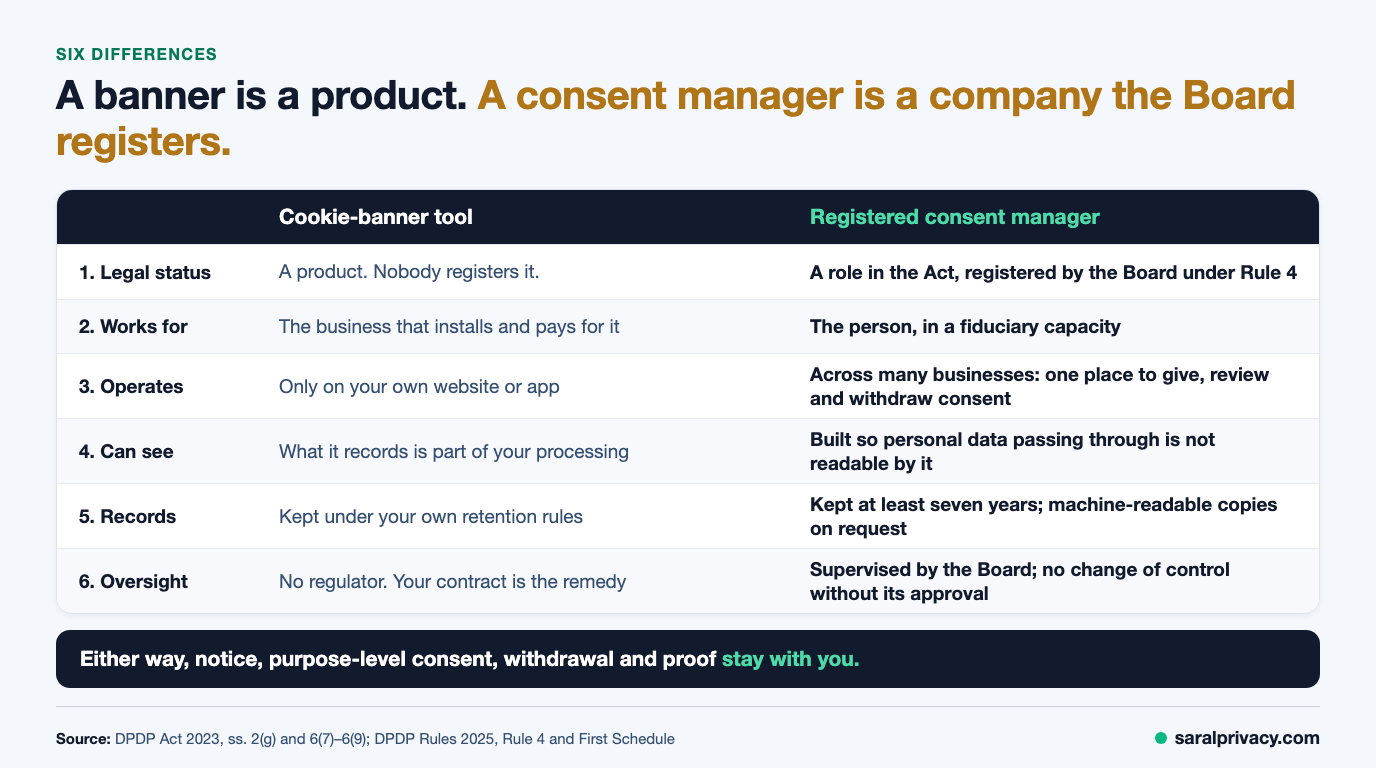
1. Legal status
A cookie-banner tool is a product. Nobody registers it, and there is no official list of approved banners.
A consent manager is a role defined in the Act (sections 2(g) and 6), with registration under Rule 4. To apply, a company must meet the First Schedule conditions: incorporated in India, a net worth of at least ₹2 crore, technical, operational and financial capacity, and an independent certification of its platform. The Board can register, suspend or cancel.
2. Whom it works for
A banner tool works for the business that installs it. The business pays and configures it.
A consent manager acts on behalf of the person. The Rules require it to act in a fiduciary capacity towards the data principal and to avoid conflicts of interest with the businesses it connects to.
3. Where it operates
Your banner stays on your own website or app, and it manages only the choices made there.
A consent manager operates across many businesses, giving one place to give, review, manage and withdraw consent (section 6(7)).
4. What it can see
A banner tool records choices and often runs on your own infrastructure or a vendor's. Whatever it records is part of your processing.
A consent manager must be built so that personal data passing through it is not readable by it. It handles the consent trail, not the contents.
5. Records and retention
With a banner tool, how long logs are kept is mostly your decision, within your own retention rules.
A consent manager must keep records of consents given, denied or withdrawn, of related notices and of data sharing, and give people access to them. The Rules set a minimum of seven years, or longer if agreed or required by law, and require machine-readable copies on request.
6. Oversight and obligations
No regulator registers or supervises a banner tool as a product. If it fails, your contract with the vendor is your remedy, and your own responsibility under the Act remains.
A consent manager sits under the Board's supervision. Control of the company cannot change hands without the Board's approval, and it cannot subcontract its obligations.
Two traps this mix-up sets
Trap 1: The banner takes the duties with it. It does not. You still need a notice that meets Rule 3. You still need consent that is specific to each purpose, or another lawful ground under section 7. You still must honour withdrawal, and you must prove consent if challenged (section 6(10)). You remain responsible for personal data that processors handle for you.
Trap 2: You pull the banner because the Act never names cookies. The Act does not mention cookie banners as such. If your site or app processes personal data on the basis of consent, you still need a way to ask for that consent and record it. A banner is one way. Removing the only way, and putting nothing in its place, leaves the proof gap open.
Using a registered consent manager is an option the Act gives people. It is not a step the Act forces on businesses. That point is in Do you need a consent manager?.
Your duties stay on your desk, banner or no banner.
How to read the line in the proposal
| If a vendor says… | Ask… |
|---|---|
| "We are a registered consent manager." | Which entry on the Board's published register? |
| "Our banner makes you DPDP compliant." | Which duties does it cover, and which does it leave to me? |
| "Government approved." | Approved by whom, under which provision? |
| "Works with all consent managers." | Which ones, and can you show a live integration? |
If you are choosing a banner or a consent platform, the vendor-neutral guide lists twelve questions to ask. Short definitions sit in the glossary.
What Kavita changes this week
She gives sales two sentences, and one rule.
"A cookie banner is a tool we use on our own site. A DPDP consent manager is a separate, registered company that a customer may choose to use to manage consents across several businesses."
One rule sits under those two sentences. Never describe any product, ours or anyone else's, as a registered consent manager unless the Board's register shows it. The same rule goes on the proposal checklist and the website review, so the line does not creep back through marketing copy.
Then she does this, in order:
- ✓Name the tool in the records: "banner/CMP", not "consent manager".
- ✓Fix the labels in the policy and on the sales pages.
- ✓Check the withdrawal path so a withdrawal reaches every system that uses the data.
- ✓Plan for a later connection, so systems can accept a withdrawal instruction from outside the brand's own preference page. What that looks like is in What changes when the first consent manager goes live.
- ✓Re-check the Board's register before anyone accepts a "registered" claim.
This week, she does only steps 1 and 2. The proposal loses the words "registered consent manager". The banner stays a banner.
Rule 4 came into force on 13 November 2026, and companies can now apply to the Board. Section 6(7), the part that lets a person act through a consent manager, starts on 13 May 2027. The note on those dates is What 13 November 2026 actually starts.
If you remember three things
- ✓A banner is a product. A consent manager is a company the Board registers.
- ✓Notice, purpose-level consent, withdrawal and proof stay with you.
- ✓Ask for the Board register entry before you accept a registered claim.
Ask for the register entry before you repeat the label.
If this split the two desks for you, send it to one sales lead, one founder, or one agency writer who is still calling a cookie banner a consent manager in a proposal.
FAQ
Is my cookie banner a consent manager under DPDP? No. A consent manager is a company registered with the Board under Rule 4.
Can a company be both? The Rules do not bar a banner vendor from applying. If one is registered, the two roles carry different duties, and a consent manager must avoid conflicts of interest with the businesses it connects to. Ask it to explain which product is which.
Do I need a banner at all? The Act doesn't mention cookie banners as such. If your site or app processes personal data on the basis of consent, you need a way to ask for and record that consent. A banner is one way to do it.
When can consent managers register? Companies have been able to apply to the Board since 13 November 2026. Applying is not the same as being registered. The Board has said it will publish the list of registered consent managers on its website. See our explainer on 13 November.
Not legal advice. This post is general information for Indian businesses. It is not legal advice. Check the Act, the Rules and the Gazette, or ask a qualified lawyer, before you rely on it.
Not sure which desk your current tool sits on? Get a plain-English privacy readiness review from SaralPrivacy. We will map your data, score your gaps, and hand you the next three actions in writing.
Sources
- 1.Digital Personal Data Protection Rules, 2025, G.S.R. 846(E), Rule 4 and First Schedule, Parts A and B[Gazette]
- 2.Digital Personal Data Protection Act, 2023, sections 2(g), 6(7), 6(8) and 6(9)[Gazette]
- 3.Press Information Bureau, Ministry of Electronics and IT, release ID 2336151, 14 November 2026[Official]
- 4.Digital Personal Data Protection Act, 2023, sections 5, 6(4), 6(10) and 8(1); DPDP Rules, 2025, Rule 3[Gazette]
Get daily briefings by email
2-min reads, plain English, every morning. Free forever.
Need expert guidance?
Our team helps Indian businesses turn DPDPA readiness into a visible trust signal.
Get Consultation →